


The High Shoulders Theory

Today at a Glance
What’s a Rich Text element?
The rich text element allows you to create and format headings, paragraphs, blockquotes, images, and video all in one place instead of having to add and format them individually. Just double-click and easily create content.
Static and dynamic content editing
A rich text element can be used with static or dynamic content. For static content, just drop it into any page and begin editing. For dynamic content, add a rich text field to any collection and then connect a rich text element to that field in the settings panel. !
- ml;xsml;xa
- koxsaml;xsml;xsa
- mklxsaml;xsa
How to customize formatting for each rich text
Headings, paragraphs, blockquotes, figures, images, and figure captions can all be styled after a class is added to the rich text element using the "When inside of" nested selector system.
When I was 12 years old, I tried out for a baseball all-star team in our area.
I really wanted to make this team. The tryouts were my first adventure beyond the confines of my small town. An opportunity to see how I stacked up against kids from all around the state.
When the results came out, the coaches called my house.
They were taking 16 players for the team...and I was the 17th on the list.
(Note: I later found out that this is what they say to everyone who doesn’t make the team, but the “just missed” feeling made the sting even worse.)
I was devastated.
It was my first real experience with failure. Something I wanted, worked towards, and came up short. I went into my room, sat on my bed, and cried.
A few minutes later, my dad walked in. He sat down on the bed next to me. After a few minutes of silence, he offered a few words:
“I know you’re upset. I understand. It sucks. But here are the three things the coaches said you needed to work on. Let’s go out every day this summer and work on them. Together.”
And we did.
I’d patiently wait for him to get home from work, holding our gloves, a bucket of balls, and a bat. He took me to the local field damn near every single day that summer. I’m sure there were days when he didn’t want to. When he was exhausted from work or travel, but it never showed.
And I came back the next year a completely different player.
Years later, when I got a scholarship to play baseball at Stanford, I still thought back to that one summer as the turning point.
But it was more than the practice that was the real turning point.
It was what my dad said in those moments as we sat on my bed, with tears streaming down my face—and how he followed through on it every day that followed.
He had two options when he walked into my room and sat next to me.
- Option 1: Tell me the coaches were idiots. I was the best player. They had made a mistake. They didn’t know what they were doing.
- Option 2: Acknowledge the pain. Tell the truth about the opportunity in the failure. And be there to support the work to meet that opportunity.
Honestly, in that moment, I probably wanted Option 1. It would have made me feel better. It would have told me that the world was the problem. That an external thing was to blame. That I was great.
Option 2 was the tough pill to swallow. But also the right one.
What my dad gave me in that room that day—and on the field every day that followed—was a foundational principle that I’ve never been able to forget. One that I’ve come to believe sits at the core of every strong relationship in life.
I call it the High Shoulders Theory…
The Two Pillars of Strong Relationships
I believe that the strongest relationships in life stand on two pillars:
- The first is high expectations. The belief that the other person is capable of excellence. That their potential is only limited by their own views. The willingness to tell the truth about that opportunity and the work required to meet it.
- The second is high support. The ability and willingness to provide the love, support, and engagement to help the other person meet those high expectations.
A lot of relationships fall short of this standard. They hit one pillar, but miss on the other.
You might imagine a 2x2 matrix with expectations on the X-axis (from low to high) and support on the Y-axis (from low to high):
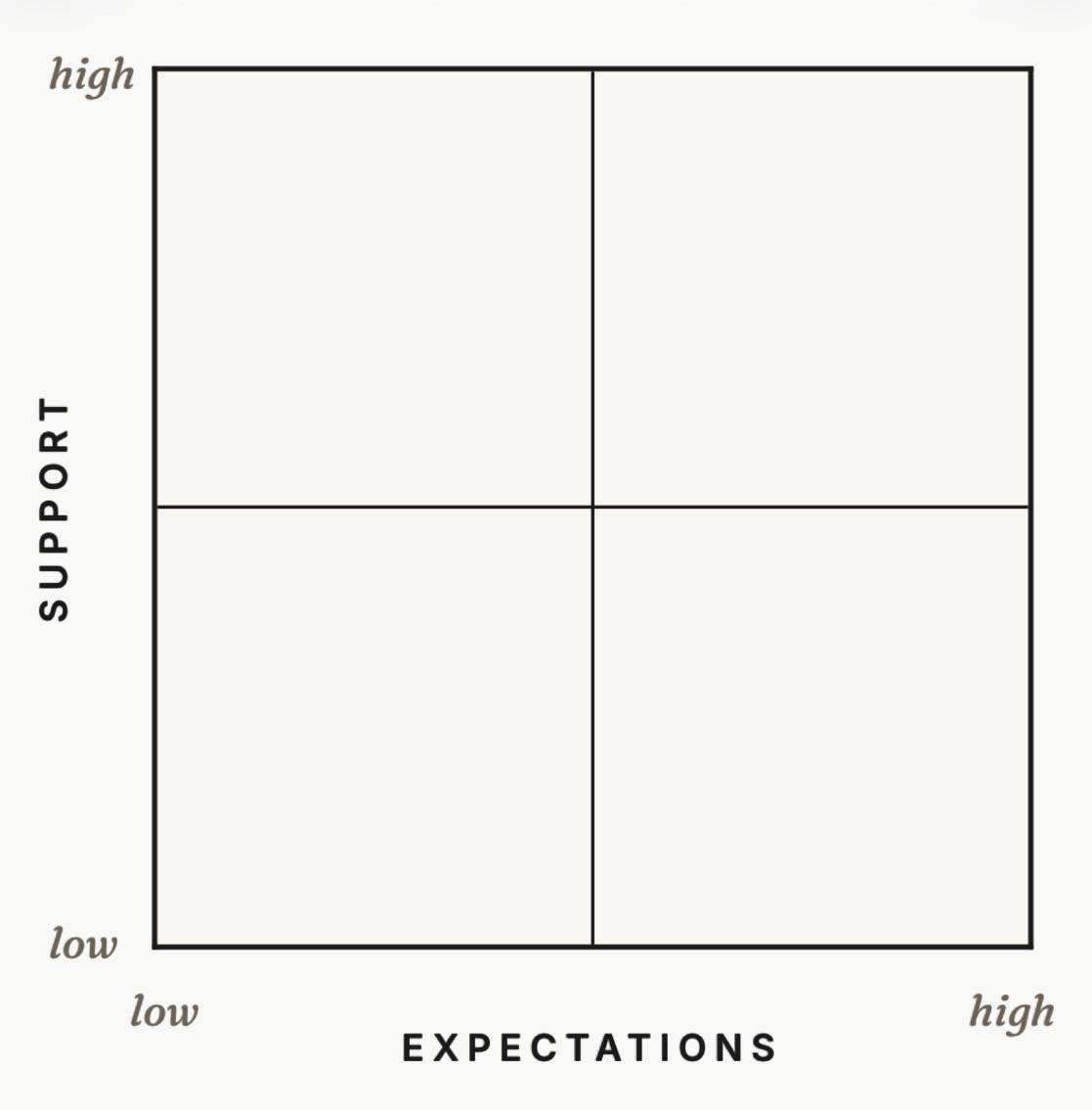
In the bottom-left quadrant, you have low expectations and low support. This is the dead zone. The drift. No one holding a standard. No one walking the path.
In the top-left quadrant, low expectations and high support. These relationships provide comfort, but no growth. They don’t challenge you. They don’t push you. They don’t lift you. You feel loved, but you slowly erode in your belief of your true potential.
In the bottom-right quadrant, high expectations and low support. These relationships may spark short-term growth, but they breed long-term resentment. The pressure builds. It’s the boss who demands more but never shows up in your corner. The parent who pushes but isn’t there in the moment of need. The friend who tells you to take the leap but disappears when you’re in the darkness. You may learn to perform, but you struggle to truly, durably grow.
In the top-right quadrant, you have your most meaningful relationships. Those people who combine high expectations and high support. Someone who tells you the truth about who you could become, and then walks that path alongside you. These are the people who change your life.
The most powerful relationships are almost always in the top-right corner of that top-right quadrant.
The Shoulders of Giants
Sir Isaac Newton famously said:
“If I have seen further than others, it is by standing on the shoulders of giants.”
It’s a beautiful line, but I think it leaves out the part that matters most.
The giants had to bend down. They had to choose to provide energy to lift him.
Their shoulders had to be high enough to see far from, but also be offered with energy and enthusiasm.
That’s the basis of my High Shoulders Theory of relationships:
The people who change your life have high shoulders. They can see the truth of your capability and potential. They believe you’re capable of realizing it. And they’re willing to lift you up onto their shoulders so you can.
High expectations and high support.
That’s exactly what my dad did the night I didn’t make that all-star team. He didn’t lower his shoulders to the level of my disappointment. He didn’t tell me the high heights didn’t matter.
He told me that I was capable of the climb—and then he gifted me with his attention and energy to help complete it.
I think about this constantly now.
It’s easy to drift into the realm of low expectations or low support. It’s easy to tell people only what they want to hear. To create an environment where people are afraid to tell you the truth. To be inconsistent in your presence.
But the strongest, most impactful relationships are built on embracing the challenge of holding the line.
This, to me, is the highest calling in our relationships:
To create an environment of high expectations with those we love and show up to support them to meet (and exceed) those expectations we’ve set.
That’s what a High Shoulders relationship means to me. It’s what I seek in those I surround myself with. And what I strive to be to those I love.
Who are the High Shoulders relationships in your life today?
If you have one, tell them. They are rare. Probably responsible for more of who you are than you realize.
And if you want to be one, the work is simple—even if it isn’t easy.
Stand tall. Bend down. Lift. Repeat.


