


The New Opportunity Razor

Today at a Glance
What’s a Rich Text element?
The rich text element allows you to create and format headings, paragraphs, blockquotes, images, and video all in one place instead of having to add and format them individually. Just double-click and easily create content.
Static and dynamic content editing
A rich text element can be used with static or dynamic content. For static content, just drop it into any page and begin editing. For dynamic content, add a rich text field to any collection and then connect a rich text element to that field in the settings panel. !
- ml;xsml;xa
- koxsaml;xsml;xsa
- mklxsaml;xsa
How to customize formatting for each rich text
Headings, paragraphs, blockquotes, figures, images, and figure captions can all be styled after a class is added to the rich text element using the "When inside of" nested selector system.
A few weeks ago, I had the unique opportunity to attend a small author’s retreat hosted by Atomic Habits author James Clear.
To be honest, it was a bit of a ”pinch-me” moment.
I was in a room with a group of 15 authors I’ve long admired, who had collectively sold tens of millions of books and left an indelible mark on the world with their ideas and insights.
We were each asked to share something that had been working for us, and once I shook off the feeling of imposter syndrome, the thing I decided to share was my framework on opportunity selection.
It sparked a deep dialogue and clearly resonated with the group—so I want to share it with all of you today.
The Two Question Test
In a general sense, I think there are two phases of your professional life:
- Phase 1: The “Yes” Phase. You want to say yes to every opportunity that comes your way. Saying yes exposes you to new things. You learn and grow at an accelerated rate. You figure things out. You try a lot of things until you find your thing.
- Phase 2: The “No” Phase. You want to say no to most things. Once you’ve identified your primary energy creators (your things), saying no allows you to focus your energy and attention on those few things that really matter. It allows you to go deep. To mine the gold.
You know you've entered Phase 2 when you have clarity on the few things that genuinely energize you.
The main challenge shifts from finding opportunities to filtering for the right ones that will compound most meaningfully in your life.
But navigating this new terrain requires an entirely different operating system.
So, you can thrive in Phase 1 but suddenly find yourself overwhelmed and stagnant in Phase 2.
A lot of people become patterned to say yes to too many things. They chase every new opportunity and end up stretched thin—an inch deep and a mile wide.
That challenge is further amplified by the fact that opportunity accelerates with success. As you progress in Phase 1, you actually have more opportunities coming your way, and you keep chasing all of them, slowly digging yourself into a deeper hole.
I experienced this struggle painfully in my early 30s.
I spent my 20s saying yes to everything—a successful Phase 1—but even as my view on my primary energy creators developed, I failed in my transition into Phase 2.
I chased after a bunch of shiny objects. Business ideas, media opportunities, networking events, and everything in between. It left me drained and a bit discouraged, as most of the opportunities failed due to the lack of energy that I had to put toward them.
The truth was that I didn’t really care about any of them. I didn’t have true energy for them. I just liked the idea of them.
And if there’s one thing I’ve learned, it’s this:
If you’re half in, you’re actually all out. Even 90% in gets you nowhere. There’s something magical in that last little bit, simply because so few are willing to do it. That’s where you unlock new levels to the game. And it doesn’t take talent, just courage to be all-in.
So, to fix this struggle, I wanted to develop a simple test for deciding when to take on (or pass on) new opportunities.
A “razor” is a rule of thumb that simplifies decision making.
I call this test my New Opportunity Razor…
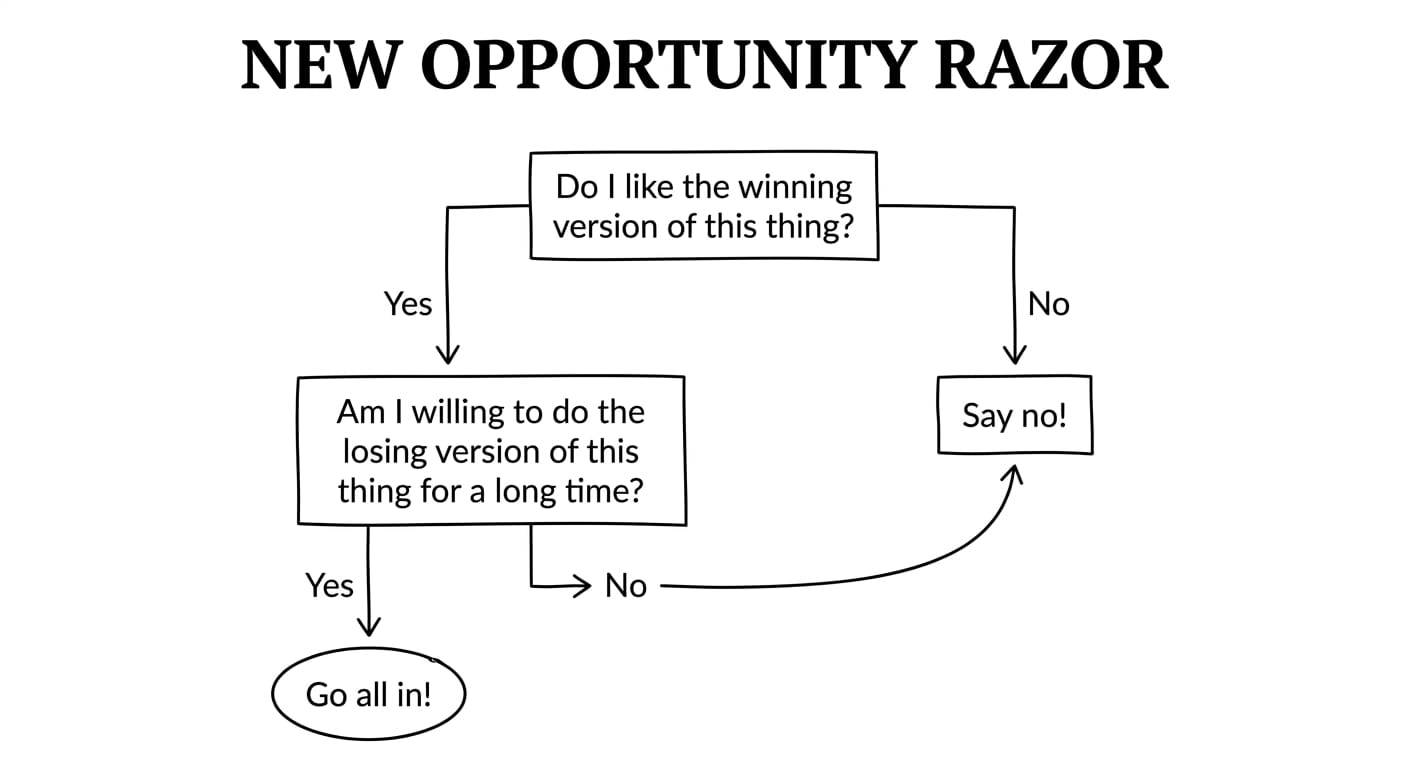
Here are the two questions to assess any new opportunity:
- Do I like the winning version of this thing?
- Am I willing to do the losing version of this thing for a long time?
Let me walk through each one to explain how it works:
1. Do I like the winning version of this thing?
Imagine yourself five years in the future. This new thing you’ve taken on is crushing it. You’re up there with the best at it.
Do you like what that looks like as it relates to your life, time, and energy?
In other words, if you make it to the top, are you going to like the view from the summit?
This is a critical first step, because too often in life we climb a mountain for years, get to the top, and realize that we never really wanted the view in the first place.
If you don’t like the life of the person in the corner office, you may want to think about that before you sacrifice 20 years grinding away to get it (or figure out how you’re going to do it differently, at least).
If the answer is no, stop here and say no to the opportunity.
If the answer is yes, proceed to the second question…
2. Am I willing to do the losing version of this thing for a long time?
To earn anything meaningful in life, it’s going to take a long, long time. Probably much longer than even your most optimistic initial assumptions.
An American computer scientist named Douglas Hofstadter once coined the self-referential adage, Hofstadter’s Law, which states:
“It always takes longer than you expect, even when you take into account Hofstadter's Law.”
So, knowing this, do you have energy to do the losing, bad, ugly version of this thing for a long time in order to earn the winning version that you like?
You may dive into something because of the appeal of the summit, but you’ll never make it there if you don’t embrace the mud you have to crawl through on the climb.
The people who have reached those summits have one common trait:
They loved the mud. They obsessed over the details. They had real energy for it.
When asked about how he had sustained his high level play for so long, tennis legend Novak Djokovic had a simple response:
"I can carry on playing at this level because I like hitting the tennis ball."
The summit is the grand slam championships. Standing on center court, holding the trophy high in the air. Everyone likes that version.
But the way you earn it is through thousands upon thousands of hours of hitting the ball. In the cold. In the dark. In the rain. When nobody’s watching. When nobody’s cheering. When nobody cares.
The losing version is the cost of entry for the winning version.
The Summit AND The Mud
The New Opportunity Razor has been a major life cheat code.
I’ve said no to more opportunities in the last year than in the previous five combined. And every no got easier, because the two questions made the answer feel obvious.
As a result, I’m more focused and energized than ever before.
I finally feel like I’m in true flow.
The best opportunities for your life will pass this test. You'll love the summit and the mud you have to navigate to get there.
When you find those things, go all in. Say no to everything else.
P.S. I’m working on a full piece on all of my favorite decision-making razors. If you’re interested in seeing that, just reply YES to this email!


