


The Tinkerer's Mindset: How to Win More

Today at a Glance
What’s a Rich Text element?
The rich text element allows you to create and format headings, paragraphs, blockquotes, images, and video all in one place instead of having to add and format them individually. Just double-click and easily create content.
Static and dynamic content editing
A rich text element can be used with static or dynamic content. For static content, just drop it into any page and begin editing. For dynamic content, add a rich text field to any collection and then connect a rich text element to that field in the settings panel. !
- ml;xsml;xa
- koxsaml;xsml;xsa
- mklxsaml;xsa
How to customize formatting for each rich text
Headings, paragraphs, blockquotes, figures, images, and figure captions can all be styled after a class is added to the rich text element using the "When inside of" nested selector system.
A group of kindergarteners outperformed the CEOs, lawyers, and MBAs.
The way they did it has a lesson I've never been able to forget...
While in college over a decade ago, I watched a TED Talk by a famed designer named Peter Skillman about an experiment he conducted in which groups of participants were given a challenge.
They were asked to build the tallest tower possible with the following items:
- 20 pieces of dry spaghetti
- 1 yard of string
- 1 yard of tape
- 1 marshmallow (which had to end up on top)
There were a variety of groups who went through this challenge:
- CEOs
- Lawyers
- MBA students
- and…Kindergarteners
The results were rather shocking:
Kindergartners outperformed all of them (and by a significant margin).
CEOs came in next, lawyers behind them, and the MBA students in last, often failing to create a structure that could withstand the weight of the marshmallow at the top.
So, the big question is why had this happened?
Well, in a later presentation, Tom Wujec, a friend of Skillman who ran the same experiment in workshops around the world, highlighted the differences in how the various groups approached the problem:
So, normally, most people begin by orienting themselves to the task. They talk about it, they figure out what it's going to look like, they jockey for power.
Then they spend some time planning, organizing, they sketch and they lay out spaghetti...And then finally, just as they're running out of time, someone takes out the marshmallow, and then they gingerly put it on top...
What kindergarteners do differently is that they start with the marshmallow, and they build prototypes, successive prototypes...so they have multiple times to fix when they build prototypes along the way...
And with each version, kids get instant feedback about what works and what doesn't work.
Interestingly, in follow-up experiments, architects and engineers performed similar or better than the kindergartners, which further reinforced the understanding of how quality results are created.
The lesson here is quite simple:
Thinking, planning, strategizing, and organizing often get in the way of doing.
This lesson hits me hard, because honestly, I see a lot of myself in the CEOs, lawyers, and yes, even the MBA students.
For most of my life, I was a big planner. When I'd decide to dive into something new, I'd spend days, weeks, and often months gathering information before I really got started.
I basically assumed life looked like this:
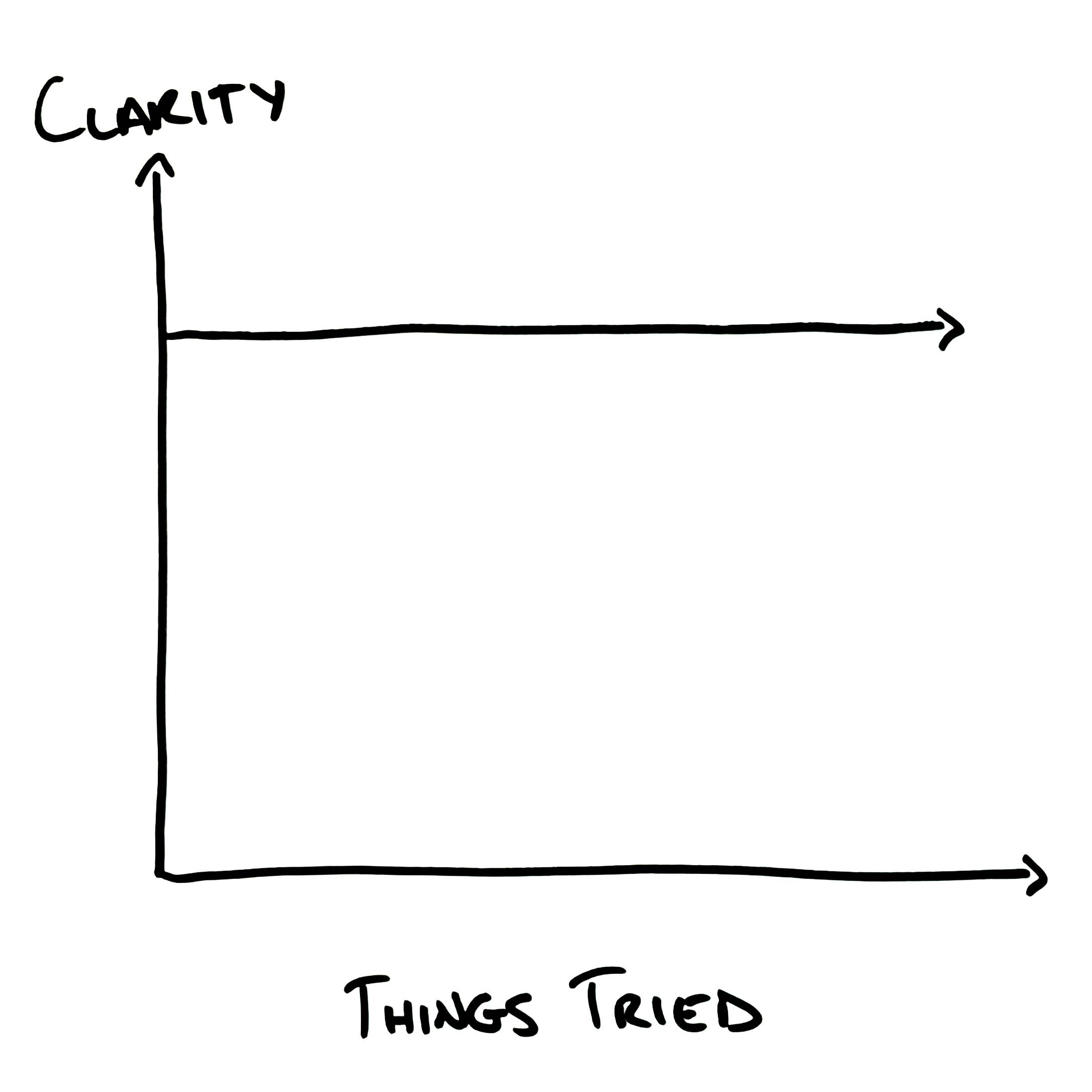
If you buy into that version of reality, you place extraordinary emphasis on the upfront work (before the graph even starts), because you believe the pre-start clarity will have to carry you through.
But it's a trap. Because while you read, research, and build business plans, you're just engaged in a dressed up version of procrastination.
As the old saying goes, you can dress up a pig in a tuxedo, but it's still a pig.
I learned it the hard way:
You can dress up procrastination however you'd like, give it some fancy names, hide behind the illusion of progress, but it's still procrastination.
The truth is that most things in life actually look like this:
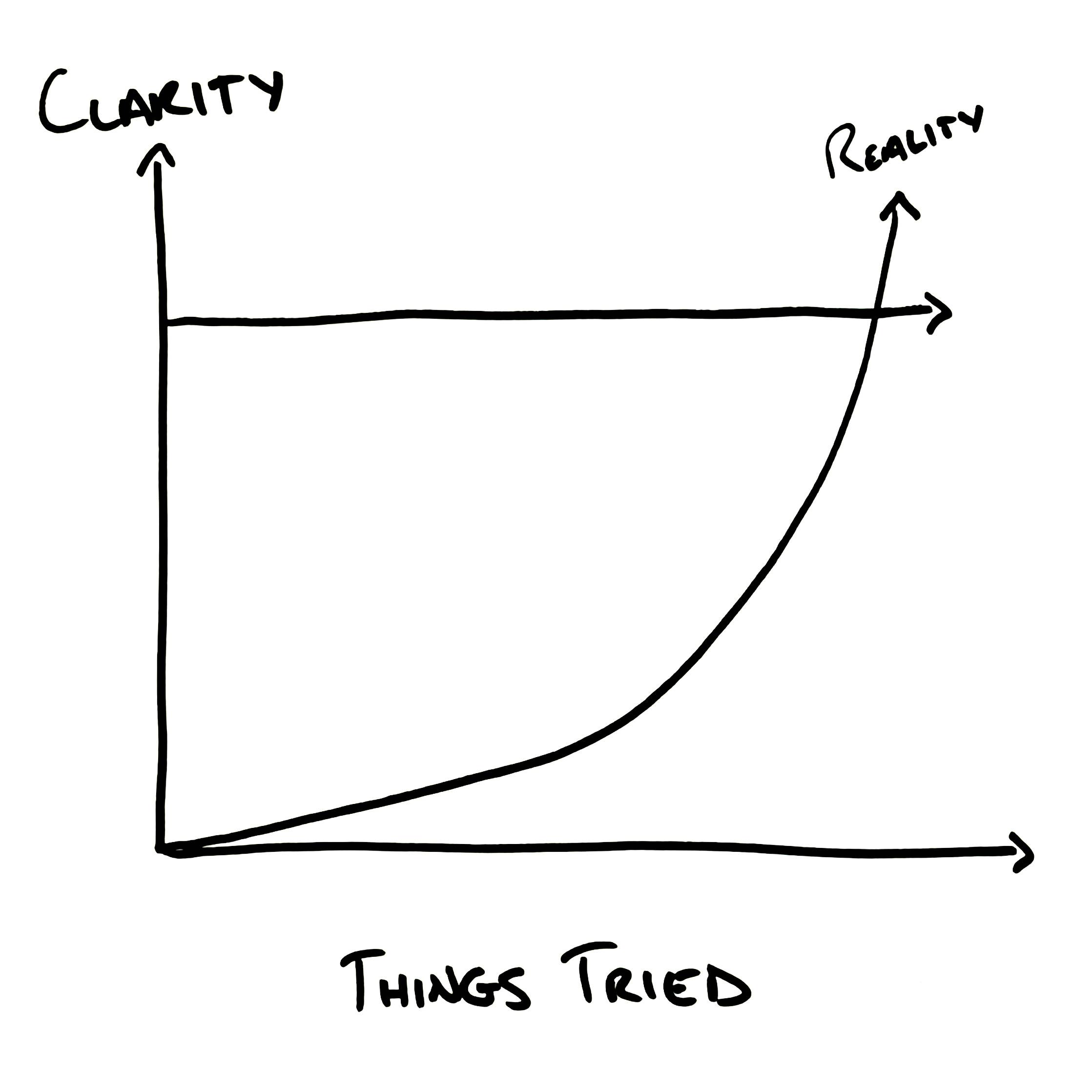
The more things you try, the more clarity you gain.
And importantly, that clarity compounds...fast.
At first, it'll feel like you're stuck and going nowhere. Then suddenly, the clarity gains in a day will surpass what you had previously been able to achieve in a month.
Clarity comes gradually, then suddenly—but only if it finds you doing.
I think of it as embracing a Tinkerer's Mindset. Try stuff. Fail quickly. Learn from each failure. Try more stuff. The cost of failure is much lower than you think. Nobody's judging you. Nobody cares.
The kindergartners weren't worried about what other people would think if their tower fell down. They weren't worried about looking or sounding smarter than anyone else in the room.
They tinkered.
We can all learn from that story:
Tinker more. Win more.


