Click Here
Cart

Order the instant New York Times bestseller: The 5 Types of Wealth

Order My NYT Bestselling Book

The Goal Gradient Hypothesis

Sahil Bloom

Welcome to the 242 new members of the curiosity tribe who have joined us since Wednesday. Join the 57,887 others who are receiving high-signal, curiosity-inducing content every single week.

What’s a Rich Text element?

The rich text element allows you to create and format headings, paragraphs, blockquotes, images, and video all in one place instead of having to add and format them individually. Just double-click and easily create content.

Static and dynamic content editing

A rich text element can be used with static or dynamic content. For static content,

just drop it into any page and begin editing. For dynamic content, add a rich text field to any collection and then connect a rich text element to that field in the settings panel. Voila!

  • mldsa
  • ,l;cd
  • mkclds

How to customize formatting for each rich text

Headings, paragraphs, blockquotes, figures, images, and figure captions can all be styled after a class is added to the rich text element using the "When inside of"

nested selector

system.

105.5.

That's how many laps you have to run around the first lane of a regulation outdoor track to cover the 26.2 miles of a marathon.

And, when I arrived at my local high school track last Friday at 4:45am, that was exactly what I planned to do.

I wish I had a thoughtful answer to the obvious "um, why?" this opener no doubt sparks in your mind.

The truth is that every now and then, I like to remind myself that I've still got that edge—that "dog" inside me. That I can take on something intimidating and get it done.

Plus, I talk a lot about discipline, grit, and consistency around here. But my rule is that you can’t talk about it if you’re not going to be about it.

If there's one thing you can always trust with me, it's this: If I say something, I’ve got receipts to prove that I live by it.

So, there I was, standing alone on the track, in the pre-dawn darkness, with 105.5 laps to go.

I hadn't told anyone I was doing it, not even my wife. That was by design. It made it more challenging. No one would know if I quit. Just me against me. A mental and physical battle, just the way I drew it up.

I pressed start on my watch and broke into stride for Lap 1.

If you've ever taken on a big, scary, ambitious goal, you know how those first few laps felt.

It's exciting. You're bubbling with anticipation at the challenge ahead. Motivated. Energized. Enthusiastic. Fresh.

But by Lap 8, that starting high had worn off and the reality of the undertaking set in.

The inner voice started getting louder:

It's cold. Why is my heart rate already 160? Am I running too fast? My legs don't feel great. This is stupid. I shouldn't do this. What if I get hurt?

I had 97 laps to go. I was nowhere close to the finish. I wasn't even close to being close to being close to the finish. Just a vast oval expanse of monotony and nothingness ahead.

Fortunately, I've researched goal-setting and achievement for many years, and as it turns out, there's real science behind this dark experience.

In 1932, a psychologist named Clark Hull ​designed an experiment​ with a group of rats that he placed in a maze with food at the end.

He noticed something interesting:

The closer they got to the end, the faster they ran.

He called it the Goal Gradient Hypothesis. It says that our effort increases as we get closer to achieving a goal. The incentive of the reward grows stronger as we approach it, so we push harder as we near the finish.

You've probably experienced this in your own life. You get a burst of energy as the "finish line" comes into view (whether it's in a marathon, a big project at work, or anything in between).

That's the Goal Gradient Hypothesis at work.

But the hypothesis also explains why the vast middle "valley" of these endeavors is so challenging to navigate. Without the reward of the finish in sight, there is a notable absence of motivation and willpower.

This is where I've found you can leverage the science to your advantage...

If I were to map my likely motivation during the course of my track marathon, it would look something like this:
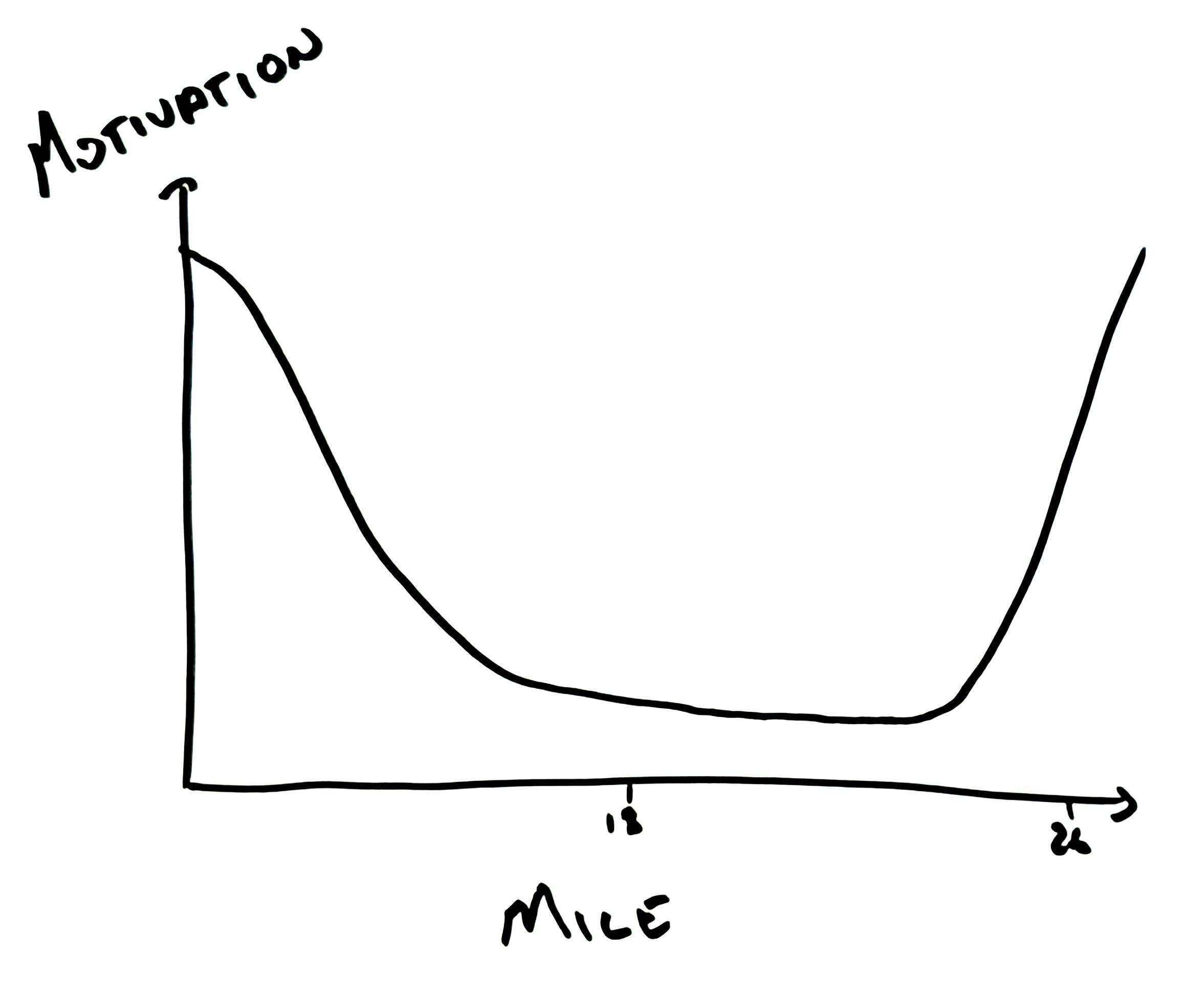
That's a serious problem. With that pattern, it would be very difficult to stay engaged, keep the pace I was hoping to hit, and finish the race.

So, as soon as I felt that Lap 8 valley darkness setting in, I changed the narrative:

I'm two miles in. At Mile 5, I've got my first gel. I like that mixed berry one I brought. It has 100mg of caffeine too, so that'll be a nice boost. I'm looking forward to taking that.

Hitting Mile 5 became my goal. Sure, I still had the distant marathon goal in mind, but Mile 5 was now the focus with the reward.

When I hit Mile 9, the same valley darkness was creeping back in, but again, I reset the focus:

I'm nine miles in. At Mile 13, I'm halfway there. That's going to feel so good, because then every step is taking me home. It's just a countdown from there.

Hitting the half marathon mark became my goal. It consumed my attention.

For the final 13 miles, I just kept creating (and reeling in) micro-goals:

At Mile 18, I only had two more miles to get to my final gel. At Mile 21, I only had 20 laps to go, so I focused on getting to 10. At 10 laps to go, the real finish line beckoned and I felt the final surge.

The new map of my actual motivation during the course of my track marathon looked like this:
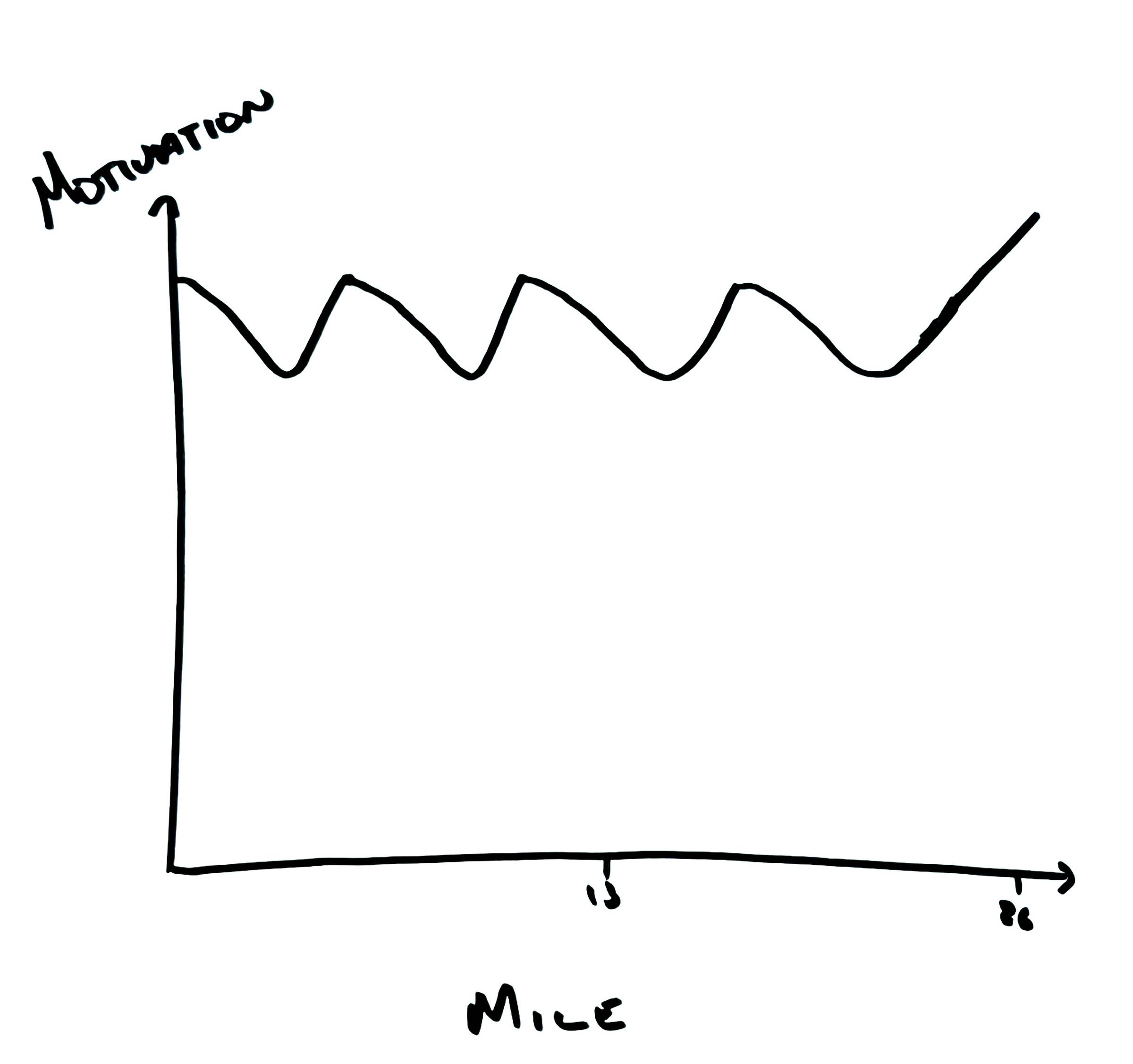
The point here is simple:

When your mind drifts into the darkness of the enormity of the task ahead, change the narrative. Create a new micro-goal. Something to look forward to. A game within a game.

The mantra I repeat in my head:

Stay plugged in.

Not plugged into the finish 90+ laps away. Because no mind is strong enough to do that.

Stay plugged in to the lap ahead of you. Stay plugged in to this straightaway. Stay plugged in to this breath.

I did.

I finished my track marathon in a final time of 2:56:16. My average pace per mile was 6:42. I didn't stop. I didn't change directions. I didn't take any breaks. It was hard. Mental torture. But I was prepared for it.

Every meaningful goal in life follows the same shape as my track marathon.

The start is exciting. The end has momentum. But the long, unglamorous middle is where the failure occurs.

The business that folds after a few months. The fitness goal that fades by February. The book that falls apart in Chapter 6.

The valley of the middle is where goals go to die. The Goal Gradient Hypothesis teaches us why—and gives us the tool to fight back.

So, the next time you're staring into the abyss, remember:

Stay plugged in.

The Goal Gradient Hypothesis

Sahil Bloom

Welcome to the 242 new members of the curiosity tribe who have joined us since Wednesday. Join the 57,887 others who are receiving high-signal, curiosity-inducing content every single week.

What’s a Rich Text element?

The rich text element allows you to create and format headings, paragraphs, blockquotes, images, and video all in one place instead of having to add and format them individually. Just double-click and easily create content.

Static and dynamic content editing

A rich text element can be used with static or dynamic content. For static content,

just drop it into any page and begin editing. For dynamic content, add a rich text field to any collection and then connect a rich text element to that field in the settings panel. Voila!

  • mldsa
  • ,l;cd
  • mkclds

How to customize formatting for each rich text

Headings, paragraphs, blockquotes, figures, images, and figure captions can all be styled after a class is added to the rich text element using the "When inside of"

nested selector

system.

105.5.

That's how many laps you have to run around the first lane of a regulation outdoor track to cover the 26.2 miles of a marathon.

And, when I arrived at my local high school track last Friday at 4:45am, that was exactly what I planned to do.

I wish I had a thoughtful answer to the obvious "um, why?" this opener no doubt sparks in your mind.

The truth is that every now and then, I like to remind myself that I've still got that edge—that "dog" inside me. That I can take on something intimidating and get it done.

Plus, I talk a lot about discipline, grit, and consistency around here. But my rule is that you can’t talk about it if you’re not going to be about it.

If there's one thing you can always trust with me, it's this: If I say something, I’ve got receipts to prove that I live by it.

So, there I was, standing alone on the track, in the pre-dawn darkness, with 105.5 laps to go.

I hadn't told anyone I was doing it, not even my wife. That was by design. It made it more challenging. No one would know if I quit. Just me against me. A mental and physical battle, just the way I drew it up.

I pressed start on my watch and broke into stride for Lap 1.

If you've ever taken on a big, scary, ambitious goal, you know how those first few laps felt.

It's exciting. You're bubbling with anticipation at the challenge ahead. Motivated. Energized. Enthusiastic. Fresh.

But by Lap 8, that starting high had worn off and the reality of the undertaking set in.

The inner voice started getting louder:

It's cold. Why is my heart rate already 160? Am I running too fast? My legs don't feel great. This is stupid. I shouldn't do this. What if I get hurt?

I had 97 laps to go. I was nowhere close to the finish. I wasn't even close to being close to being close to the finish. Just a vast oval expanse of monotony and nothingness ahead.

Fortunately, I've researched goal-setting and achievement for many years, and as it turns out, there's real science behind this dark experience.

In 1932, a psychologist named Clark Hull ​designed an experiment​ with a group of rats that he placed in a maze with food at the end.

He noticed something interesting:

The closer they got to the end, the faster they ran.

He called it the Goal Gradient Hypothesis. It says that our effort increases as we get closer to achieving a goal. The incentive of the reward grows stronger as we approach it, so we push harder as we near the finish.

You've probably experienced this in your own life. You get a burst of energy as the "finish line" comes into view (whether it's in a marathon, a big project at work, or anything in between).

That's the Goal Gradient Hypothesis at work.

But the hypothesis also explains why the vast middle "valley" of these endeavors is so challenging to navigate. Without the reward of the finish in sight, there is a notable absence of motivation and willpower.

This is where I've found you can leverage the science to your advantage...

If I were to map my likely motivation during the course of my track marathon, it would look something like this:

That's a serious problem. With that pattern, it would be very difficult to stay engaged, keep the pace I was hoping to hit, and finish the race.

So, as soon as I felt that Lap 8 valley darkness setting in, I changed the narrative:

I'm two miles in. At Mile 5, I've got my first gel. I like that mixed berry one I brought. It has 100mg of caffeine too, so that'll be a nice boost. I'm looking forward to taking that.

Hitting Mile 5 became my goal. Sure, I still had the distant marathon goal in mind, but Mile 5 was now the focus with the reward.

When I hit Mile 9, the same valley darkness was creeping back in, but again, I reset the focus:

I'm nine miles in. At Mile 13, I'm halfway there. That's going to feel so good, because then every step is taking me home. It's just a countdown from there.

Hitting the half marathon mark became my goal. It consumed my attention.

For the final 13 miles, I just kept creating (and reeling in) micro-goals:

At Mile 18, I only had two more miles to get to my final gel. At Mile 21, I only had 20 laps to go, so I focused on getting to 10. At 10 laps to go, the real finish line beckoned and I felt the final surge.

The new map of my actual motivation during the course of my track marathon looked like this:

The point here is simple:

When your mind drifts into the darkness of the enormity of the task ahead, change the narrative. Create a new micro-goal. Something to look forward to. A game within a game.

The mantra I repeat in my head:

Stay plugged in.

Not plugged into the finish 90+ laps away. Because no mind is strong enough to do that.

Stay plugged in to the lap ahead of you. Stay plugged in to this straightaway. Stay plugged in to this breath.

I did.

I finished my track marathon in a final time of 2:56:16. My average pace per mile was 6:42. I didn't stop. I didn't change directions. I didn't take any breaks. It was hard. Mental torture. But I was prepared for it.

Every meaningful goal in life follows the same shape as my track marathon.

The start is exciting. The end has momentum. But the long, unglamorous middle is where the failure occurs.

The business that folds after a few months. The fitness goal that fades by February. The book that falls apart in Chapter 6.

The valley of the middle is where goals go to die. The Goal Gradient Hypothesis teaches us why—and gives us the tool to fight back.

So, the next time you're staring into the abyss, remember:

Stay plugged in.