


I Think I'm Having a Reverse Midlife Crisis

Today at a Glance
What’s a Rich Text element?
The rich text element allows you to create and format headings, paragraphs, blockquotes, images, and video all in one place instead of having to add and format them individually. Just double-click and easily create content.
Static and dynamic content editing
A rich text element can be used with static or dynamic content. For static content, just drop it into any page and begin editing. For dynamic content, add a rich text field to any collection and then connect a rich text element to that field in the settings panel. !
- ml;xsml;xa
- koxsaml;xsml;xsa
- mklxsaml;xsa
How to customize formatting for each rich text
Headings, paragraphs, blockquotes, figures, images, and figure captions can all be styled after a class is added to the rich text element using the "When inside of" nested selector system.
"I think I'm having a midlife crisis."
That's what my friend, who I'll call Joe, said to me at dinner a few weeks ago. Joe is in his early-40s. He's had a good career on a steady rising track in the world of finance. He's married with two kids, ages 7 and 4. He lives in the suburbs outside New York and commutes into the city for work.
In many respects, I think of Joe as something of an archetype of the dream. Good job. Good family. Good life.
So, naturally, his words caught me off guard.
When I inquired what he meant, he said that he'd been spending more time with younger colleagues and found himself growing increasingly jealous of their freedom. Scrolling on Instagram, he'd found his feed filled with images of a tantalizingly unlived life. He'd started to feel intense impulses to do all the things he felt he was running out of time to do. It was making him question everything about his life and his choices to date.
To be clear, there's no judgement here.
I've had a similar conversation with a lot of people over the last few years and I've received hundreds of emails from readers alluding to the same. The midlife crisis is an all-too-common phenomenon.
In my view, the midlife crisis isn't driven by ego, vanity, or lust so much as fear. Fear of a door permanently closed. Fear of a road not taken. Fear of a season past.
But after the conversation, as I reflected on my own life, at a roughly similar life stage, I have to be honest about something:
I think I'm having a Reverse Midlife Crisis.
I've felt that exact same fear. I know it well. Time is something I think about a lot. I mean, I wrote a book that was (at least in part) about the fleeting nature of time. A book that opens with a striking line about my life-changing realization that I'd only see my parents fifteen more times before they were gone.
And as my life has progressed, particularly with the birth of my son in 2022, I've only grown more aware of the passing of this one most precious asset. Something about the juxtaposition of the newness of my son's life with the suddenly apparent maturity of my parents' lives has shined a light on its acceleration.
There's something called Janet's Law, named after 19th century French philosopher Paul Janet, which argues that time speeds up as you get older because each year is a smaller fraction of your total life.
It explains why your early years feel long, but as you get older, the years seem to fly by.
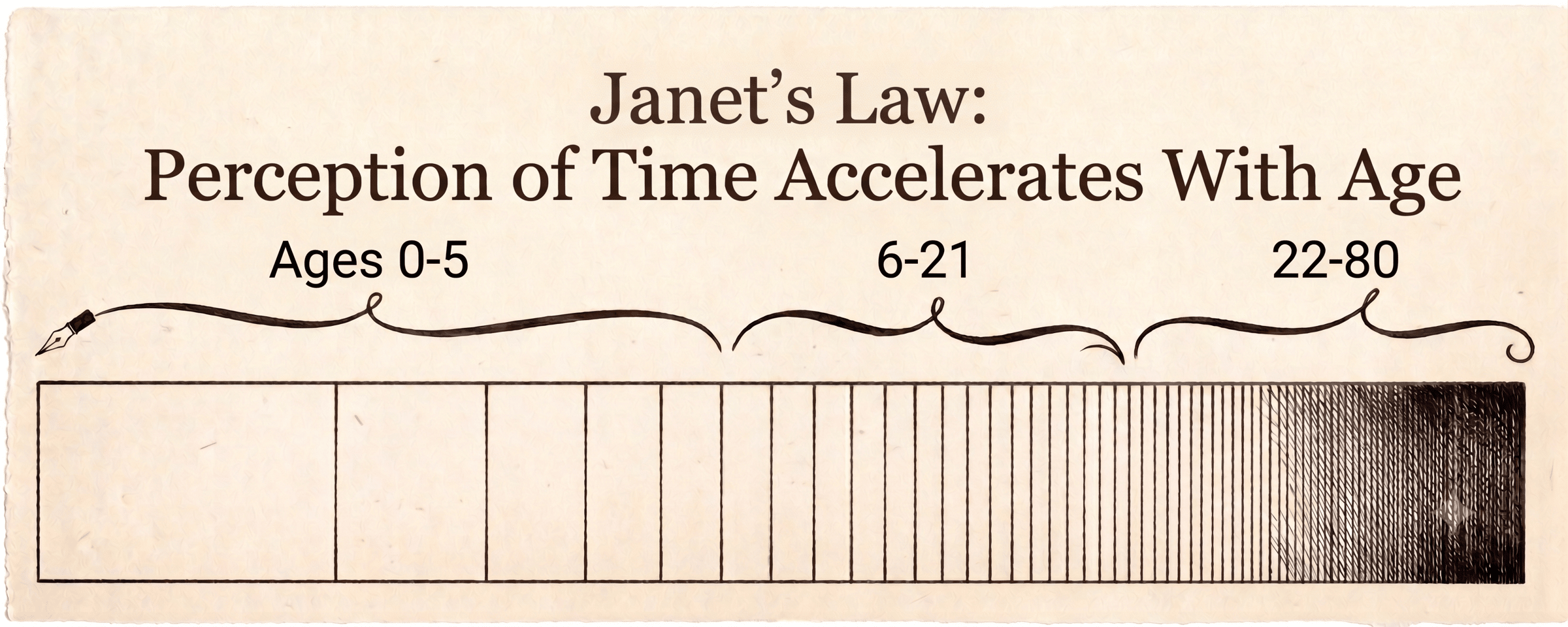
My friend George Mack captured this well:
When you’re 5 years old, a year is 20% of your life. And when you’re 50 years old, a year is 2% of your life. Janet’s Law states that you experienced roughly half of your perceived life by 20 years old.
Or to put it another way: The summer for a 5 year old feels as long as the 10 years from 40 to 50 years old.
So, yes, I know that fear. But my response to it has been very different.
The Midlife Crisis is about action that chases feelings from the past.
It's about re-living those things that your 18-year-old self would find very impressive. Fast cars. Young, attractive romantic partners. Fancy stuff. Status symbols. Limited responsibilities.
The Reverse Midlife Crisis is about presence that compounds meaning for the future.
It's about building those things that your 80-year-old self will find impressive. Deep relationships. A healthy, fit body. A grounded, peaceful mind. Earned status. Meaningful responsibilities.
In other words, if a Midlife Crisis is about impressing the person you used to be, a Reverse Midlife Crisis is about sparking pride in the person you will become.
They both start in the same place. With the same fear, the same anxiety, the same grief over time lost. Their only difference is the direction of the response.
I began noticing the signs of my Reverse Midlife Crisis about a year ago, long before I had a term for what I was experiencing:
- I started choosing peace. Life has enough chaos. I stopped tolerating people who invite it. No drama. I just don't have energy for it anymore. I value being able to come home to calm.
- I started relishing quiet mornings and early evenings. I genuinely look forward to my 4:30am reading and writing ritual. And to my 8:30pm bedtime television show with my wife.
- I stopped spending to impress an audience that was never watching. The compulsion to signal my success to the outside world quietly disappeared. The symbols were fake, cheap freedom. Saving and investing brought the real thing.
- I started treating my health as a long-term investment. It was no longer about some arbitrary performance target. I want to move every day. Eat the best quality fuel. And sleep to allow it to recover.
- I stopped avoiding hard conversations. It's always much easier to just brush things under the rug, but time doesn't heal anything when it comes to relationships.
- I started looking forward to a night in with my wife, son, and family more than a big night out. Enjoying simple, home cooked meals more than fancy ones. Falling in love with routine more than novelty. Reading old books more than hot takes. Doing hard things just for the hell of it.
I'm the first to admit a lot of that would sound boring to my 18-year-old self. He'd never believe that I'd choose that over any of the tempting instant gratification that I could certainly chase.
But at 35, I'm not here to impress my 18-year-old self. He's gone. A relic of a past season I don't feel a need to cling to. I'm here to live this season. To be present. And to compound for all those seasons to come.
Philosopher and writer George Santayana put it beautifully:
"To be interested in the changing seasons is a happier state of mind than to be hopelessly in love with spring."
That's my Reverse Midlife Crisis. I think there are three core pillars to it:
1. Subtract, don't add.
Learn to recognize things that don’t matter. The world will pressure you to care about every single thing. To add more and more. To go after every problem. To take every slight personally. To have opinions on everything. Reject that trend. Just focus on a few, and ignore the rest.
If life is short, and it's getting shorter, you want less, but better. In all things.
2. Invest, don't spend.
Time is either invested or spent:
- Invested: Actions that compound long-term value.
- Spent: Actions that don’t.
Generally speaking, spent time feels good now but bad later. Things like scrolling on social media and chasing instant gratification. Invested time varies in the present but always feels good later. Things like slowing down, doing hard things, focusing, being present.
Time is your most precious asset. Seek to invest far more than you spend.
3. Be, don't chase.
In a world that wants you to rush, the ultimate act of rebellion is presence.
Be in the season you're in. Don't chase the past. Be here. Be now. Be in this. All of its texture, depth, and struggle. All of its joy, tension, and pain. Sit with the uncertainty. Become friends with it. Fall in love with it.
I've never said any of that out loud. I've never even really thought about it until sitting down to write this piece. But it feels important.
Many of us stand at a crossroads of some sort. Whether you're 25, 45, 65, or even 85, you feel that same fear. The same clock is ticking on all of us. Some season has come to an end.
The only thing we get to choose is how we respond to it.
Do you cling to the past, chase it, hopelessly in love with spring?
Or, do you stand in the present, smile at the opportunity, remaining interested in the changing seasons?
Your younger self will always sing its siren's song, begging you to run back. Don't listen. Make your older self proud instead.
I'm having a Reverse Midlife Crisis. And I couldn't be any happier about it.
Who wants to join me?


