


5 Reflections From My Think Week

Today at a Glance
What’s a Rich Text element?
The rich text element allows you to create and format headings, paragraphs, blockquotes, images, and video all in one place instead of having to add and format them individually. Just double-click and easily create content.
Static and dynamic content editing
A rich text element can be used with static or dynamic content. For static content, just drop it into any page and begin editing. For dynamic content, add a rich text field to any collection and then connect a rich text element to that field in the settings panel. !
- ml;xsml;xa
- koxsaml;xsml;xsa
- mklxsaml;xsa
How to customize formatting for each rich text
Headings, paragraphs, blockquotes, figures, images, and figure captions can all be styled after a class is added to the rich text element using the "When inside of" nested selector system.
Last week, my business partner and I held our quarterly "Think Week" retreat.
The plan for this retreat was straightforward:
- 2 days
- Limited connectivity, no meetings
- Unstructured schedule
- Question prompts as catalysts to zoom out
- Focus on deep conversations, journaling, thinking, and reflecting on business ventures, relationships, health, and life.
I always leave these retreats with new perspectives and insights. And, in the interest of openness, and because I think many of them are broadly applicable, I try to share them here with all of you.
So, here are 5 things I've been thinking about:
P.S. For those who are interested, you can find a full guide I created for conducting your own Think Week (or easier Think Day) here.
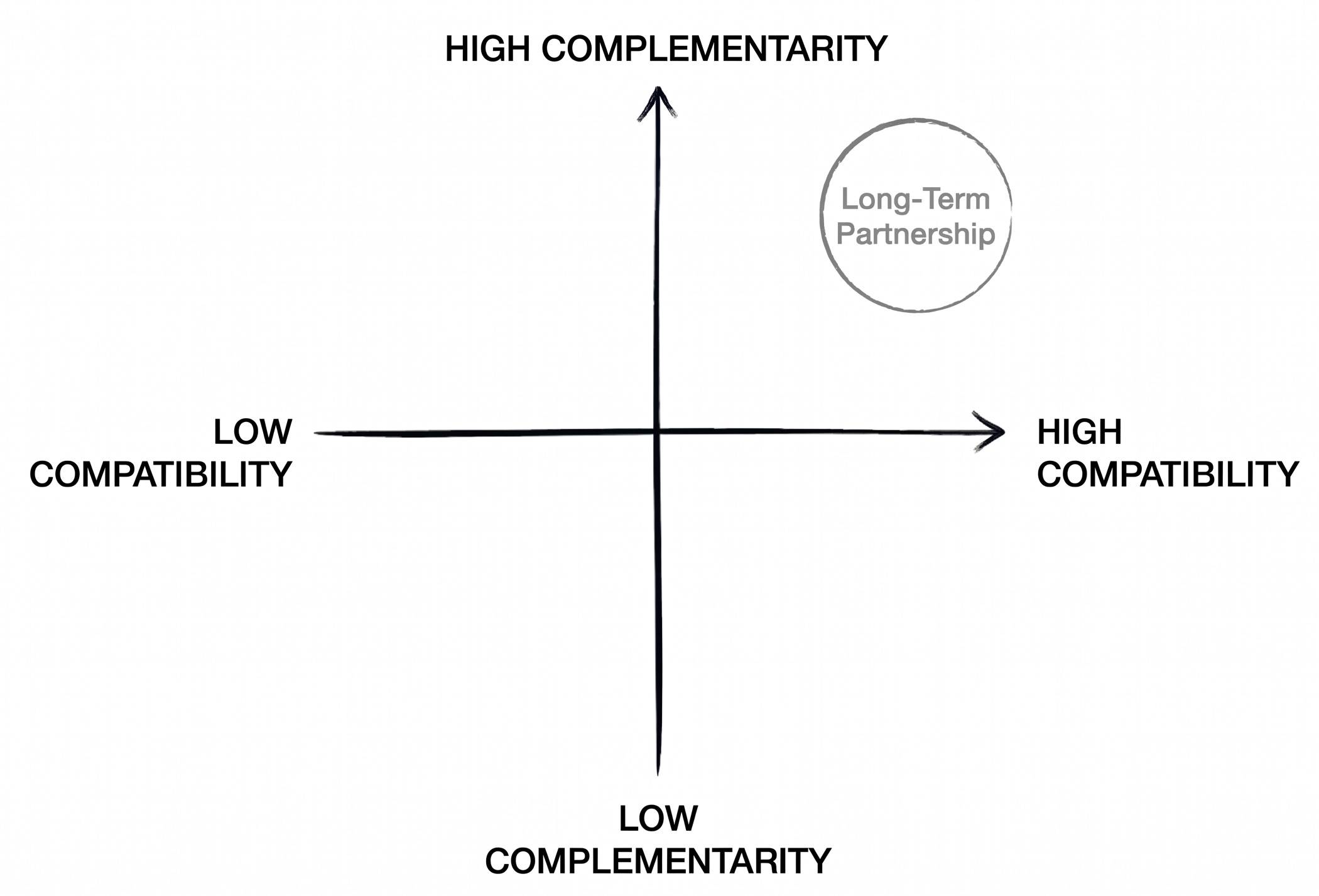
1. Your deepest partnerships will be both compatible and complementary.
Compatibility is the alignment of core values, principles, and perspectives. I think of it as being about the degree to which you and another person share the core lens through which you see the world.
It's what most people focus on when it comes to relationships. With friends, romantic partners, colleagues, or business partners.
And when it comes to a lot, maybe even most, of your relationships, compatibility is probably enough for it to feel like a smooth, low-friction relationship.
But when you're seeking out the deepest partnerships in your life and business, compatibility alone falls short.
You need complementarity.
Complementarity is about having different traits, strengths, and styles that balance each other out rather than mirroring one another.
Compatibility is a good anchor. It's a strong grounding for a relationship. Complementarity is what allows that relationship to thrive across the changing seasons of life or business. It allows you to constantly learn from one another, tackle inevitable challenges from different angles, and cover each other's weaknesses.
When you find those rare people with whom you're both compatible and complementary, cherish them.
2. The opportunity cost of inaction is dynamic.
I've often talked about the value of having a bias for action. Of defaulting to movement. Doing things. Making the play. Taking the leap. Whatever it is.
And while I continue to believe that it's a good base mindset, there is some nuance I've come to understand.
Namely, the "cost" of inaction changes at different times on your journey.
Early on in your life and career, the cost of doing nothing is extremely high.
You don't know anything yet. You don't know what works. You don't know what doesn't work. You don't know which collisions will create the ultimate outcomes you want. And you can't predict any of that with any degree of accuracy.
So, every moment that you overthink and fail to act is a moment you could be building new insights, perspective, relationships, experience, and everything in between.
It's very costly to do nothing.
But as you start to experience more success, as you start to figure out what works, that cost of inaction slowly declines.
Because the best things in life come from compounding. Stacking wins on top of wins. And to do that, you have to be more and more precise and deliberate with your energy. You have to push, but on the right things, in the right direction.
The shiny object you chase becomes the greatest risk to your continued acceleration.
The cost of inaction gets quite low. Not acting on the vast majority of opportunities is actually the right move.
The hard part is identifying where you are on this journey.
A simple way I like to think about it:
Are you still trying to figure out what works? Or, do you know what works, and just need to focus on it?
3. Build your engine and maintain your brakes.
Imagine a race car zipping around a tight track. Speeding down the straightaways. Firing into the turns. Whipping around corners.
What allows the driver to do all of that?
I think there are really two core things:
- Strong engine
- Confidence in the brakes
A strong engine alone is never enough. You could have the fastest car in the world, but if you knew the brakes had a 50/50 chance of working, you'd never bomb down a straight into a turn. You'd be too nervous. You'd slow down and watch as the race slipped away.
The same is true for your life. You need both.
You obsess over the engine:
- Building skills
- Accumulating knowledge
- Stacking experience
- Forming networks
But how much energy are you putting into maintaining your brakes?
- Building rest into your schedule
- Creating space for boredom, free time, reflection
- Slowing down
- Focusing on presence
The single greatest challenge for any ambitious person is eliminating the guilt associated with rest, slowness, and free time.
Reframe these acts as part of your performance, rather than a reward for your efforts.
You need the well-maintained brakes if you want to win the long race.
4. The greatest gift is a calm home.
While the retreat did create a lot of space for business-related reflections, the most powerful insights from these experiences are almost always personal in nature.
I had a crazy year. Over 50 speaking engagements. New business launches. A new book in the works. I was all over the place. But somehow, while stretched, I don't feel destroyed.
I pushed myself to think on what had enabled that. How had the year been so intense, yet minimally draining?
The answer felt obvious:
A calm home.
No matter what is going on in my professional life, I know that I come home to peace.
My wife is the perfect example of someone with whom I'm compatible and complementary. The deep empathy, kindness, patience, and love with which she lives are an inspiration to me every single day. Something that fills me with awe whenever I slow down enough to appreciate it.
Most of all, I appreciate that she creates a calm home.
I've come to believe that the greatest gift is a calm home. It's really not the big house or the fancy stuff that ripples through your life. It's having a place where you feel safe. Where everyone can be themselves. Where there's no need to perform. Where the nervous system can just relax. Where the hard conversations happen, but they're always followed by a thoughtful repair. Your environment is, quite literally, everything.
Create peace at home and you carry it everywhere you go.
5. Think less to achieve more.
Ending a piece about reflections from a Think Week with advice to "think less" feels like a good bit of irony, but stick with me.
Sometimes, you do need to think less. But thinking is different from reflecting.
Think Weeks (or Think Days) are a tool for reflection. You slow down and create a fixed moment to zoom out and reflect. To identify your gaps and blind spots. To see the course corrections that need to happen.
Thinking, and its closely related cousin, overthinking, happen in the moment. There's no slowdown or pause. There's no approach. You're moving on something and you start thinking about it. It's repetitive. Obsessive at times. You start getting in your own head. You build the thing up beyond the point of value.
I am prone to overthinking around certain things. The conclusion of this week taught me the lesson that it's time to stop.
I had signed up for the Indianapolis Marathon, which was set to take place on Saturday. I was going to be at my retreat from Monday to Thursday (including travel), go straight to a speaking engagement in San Diego on Friday, and then fly to Indianapolis.
I'd arrive at 9pm on Friday, run the race at 8am on Saturday, and then catch a 1pm flight home to my family.
In the past, with a marathon on the schedule, I'd have spent the entire week obsessively thinking over every detail. The carb load. The hydration. The workouts during the week. I'd lose sleep, have anxiety dreams, and inevitably psych myself out.
This time, none of that happened, because I quite simply didn't have the bandwidth to think about it. I was on the move with the crazy week.
I didn't think about the race all week. I didn't really carb load. I didn't obsess over every detail. I didn't dream about the race. I didn't stress over how I'd feel on race day.
I didn't even think about the race until Friday when I landed in Indianapolis at 9pm.
I got to sleep around 11:30 (I'd been on West Coast time all week), woke up at 6:30, took a quick shower, and got out to the start line.
And...I ran a 5-minute personal best. Finishing in 2:48:21 and putting to rest the question of whether I could execute on a sub-2:50 time in an official race.
I just ran.
Sometimes, when you remove the weight of expectations, of all the thinking, you show up with a lightness that just can't be contained.
Think less, achieve more.
Psychologist Viktor Frankl once wrote the following:
"Between stimulus and response, there is a space. In that space is our power to choose our response."
Our power is in the space that we can create between stimulus and response.
The "Think Week" is a ritual for creating that space. Whether you have an hour or a few days, I can't recommend it more highly.
Because here's the truth:
The growth you seek is found in the space you avoid.
P.S. For those who are interested, you can find a full guide I created for conducting your own Think Week (or easier Think Day) here.


