The $10,000 Leak That Cost $2 Billion

Today at a Glance
What’s a Rich Text element?
The rich text element allows you to create and format headings, paragraphs, blockquotes, images, and video all in one place instead of having to add and format them individually. Just double-click and easily create content.
Static and dynamic content editing
A rich text element can be used with static or dynamic content. For static content, just drop it into any page and begin editing. For dynamic content, add a rich text field to any collection and then connect a rich text element to that field in the settings panel. !
- ml;xsml;xa
- koxsaml;xsml;xsa
- mklxsaml;xsa
How to customize formatting for each rich text
Headings, paragraphs, blockquotes, figures, images, and figure captions can all be styled after a class is added to the rich text element using the "When inside of" nested selector system.
On the morning of April 13, 1992, while commuters in downtown Chicago were grabbing coffee and heading to their desks, fish were swimming in the basement of one of the largest buildings in the city.
To the commuters, everything appeared entirely normal, but right beneath their feet, an estimated 250 million gallons of water were flooding into the city's forgotten network of underground tunnels and basements.
Just a few hours later, hundreds of thousands had to be evacuated from the area, and the subway and several large commercial buildings were closed.
In the end, nobody was hurt, but the direct damage from the flooding and the lost economic activity from the extended closures was estimated to have cost the city nearly $2 billion.
The incident, now commonly referred to as the Great Chicago Flood, is most memorable not for its ending, but for the impossible irony of its beginning.
First, a short bit of history:
In 1899, the city granted a special permit to the Illinois Telephone and Telegraph Company to build underground conduits for phone cables 40 feet below downtown.
The company soon pivoted and secured city approval to expand the tunnel network into an underground freight system.
By 1914, the tunnel network under the city spanned roughly 60 miles and connected the sub-basements of major department stores, railroad depots, and office buildings all around downtown Chicago.
But in 1959, as trucks became the standard fare for city deliveries, the underground railway system was abandoned.
The extensive tunnel network sat largely forgotten for over 30 years, until late 1991, when a group of contractors driving wooden pilings into the Chicago River unknowingly cracked the wall of one of the tunnels.
In January 1992, cable workers inspecting lines in one of the tunnels stumbled upon the small damaged section, which was oozing mud and river water.
On April 2, 1992, after reviewing details of the breach himself, Chief Bridge Engineer Louis Koncza sent an urgent memo to the city recommending immediate action. He warned that the small breach had the potential to flood the entire tunnel system and requested an immediate crew to fix the issue.
The total estimated cost to do so: $10,000.
But rather than sparking decisive action, the memo and associated repair cost figure triggered a series of bureaucratic delays, with the city administrators putting the repair out to bid.
When the first round of bids came in higher than the $10,000 original, a decision was made to request a second round.
And as that was happening, just 11 days after the memo, the catastrophic flood Koncza predicted became a reality.
They saved $10,000, but it cost them $2 billion...
It's easy to read this story and have a good laugh at their expense. But to be perfectly honest, we all make the same mistake in our own lives.
They hadn't ignored the leak. They just approached it with the wrong level of importance and urgency.
They priced the leak, not the flood.
It's an all-too-common mistake in the way we think about risk. We judge the problem by its current size and fail to appropriately weight what it could become.
In Chicago, the small leak received an appropriate amount of attention and urgency for its current size, but a dramatically underweight amount for its future size.
The odds of the small leak becoming a catastrophic flood certainly weren't 100%, but they weren't 0% either.
Say they were 5%. Applying a 5% probability to a $2 billion issue is $100 million in probability-adjusted damages. Even 1% is $20 million.
So, if you're thinking logically, spending $10,000 (or $75,000, as other bids proposed) to prevent probability-adjusted damages in the tens of millions is an easy choice.
The problem is three-pronged:
1. You think it can't happen.
You rarely think the small leak can become the enormous flood, so you underestimate (or completely ignore) the probability of it occurring.
In effect, you round the odds to zero.
A Wharton decision science researcher named Howard Kunreuther studied this habit for decades. His work suggests that when a disaster appears sufficiently rare, people treat it as impossible instead of unlikely. Therefore, they take no steps to protect themselves against the disaster.
This is an importance problem.
2. You think it'll stay small.
You rarely appreciate the full scale of the damages if it does occur, so you underestimate how bad it could actually get.
Your vision of the future is anchored by the picture of what it looks like today. Small.
This is an importance problem.
3. You think it'll wait for you.
You treat the odds (and damages) as fixed, when they aren't.
Time is a lever for compounding, good and bad. Small problems become big problems when unaddressed for an extended period of time.
With a lot of problems in life, the longer you wait, the higher the odds, and the greater the potential damages.
This is an urgency problem.
Chances are you have a "$10,000 leak" somewhere in your life right now. It's something small. Something easy to ignore. Easy to push off as a problem for next week, next month, or next year.
Think about what those might be in your life.
It could be a relationship tension. A health issue. A business model problem. A financial vulnerability. Whatever.
Then run them through the three problems above to see whether you're appropriately weighting your response:
- Odds. You think it can't happen. Are you rounding the odds of the small leak becoming a massive flood to zero? What are the true odds?
- Damages. You think it'll stay small. Are you failing to see the full scale of the potential damages if it does occur? What are the true damages?
- Time. You think it'll wait for you. Are you failing to see the impact of time delays on the odds and damages? What's the true cost of waiting?
Then, compare your responses to those questions with the cost of addressing the leak today.
You may find, like Chicago might have, that you can spend $10,000 to save $2 billion.
Here's a simple example of how I ran through this recently in my own life:
I'm far from a doomsday prepper, but all of the recent news around cyberattacks had me thinking a bit more clearly about my family's exposure to such an event.
Specifically, I was thinking about the risk of an extended electrical grid outage (let's say a month).
I might say there's a 1% chance of this happening. Very low, but if unprepared for it, the potential damage to my family would be pretty catastrophic. No electricity for a month means no clean water, no heat in the winter, no ability to cook, etc.
It's a small vulnerability that I can fix with a tiny amount of money, by buying some extra water, shelf stable food, and some backup heating devices.
But the fix is only cheap if I do it now. Trying to buy these things after an event would be a completely different story.
The point is that thinking through it deliberately reminded me that even low probability events are worth protecting against when the damage if they occur is significant enough.
It's uncomfortable to think about these things. But it's important.
Remember: A good life is built by simply doing uncomfortable things sooner.
The delayed conversation gets harder. The ignored problem gets bigger. The small repair gets more expensive.
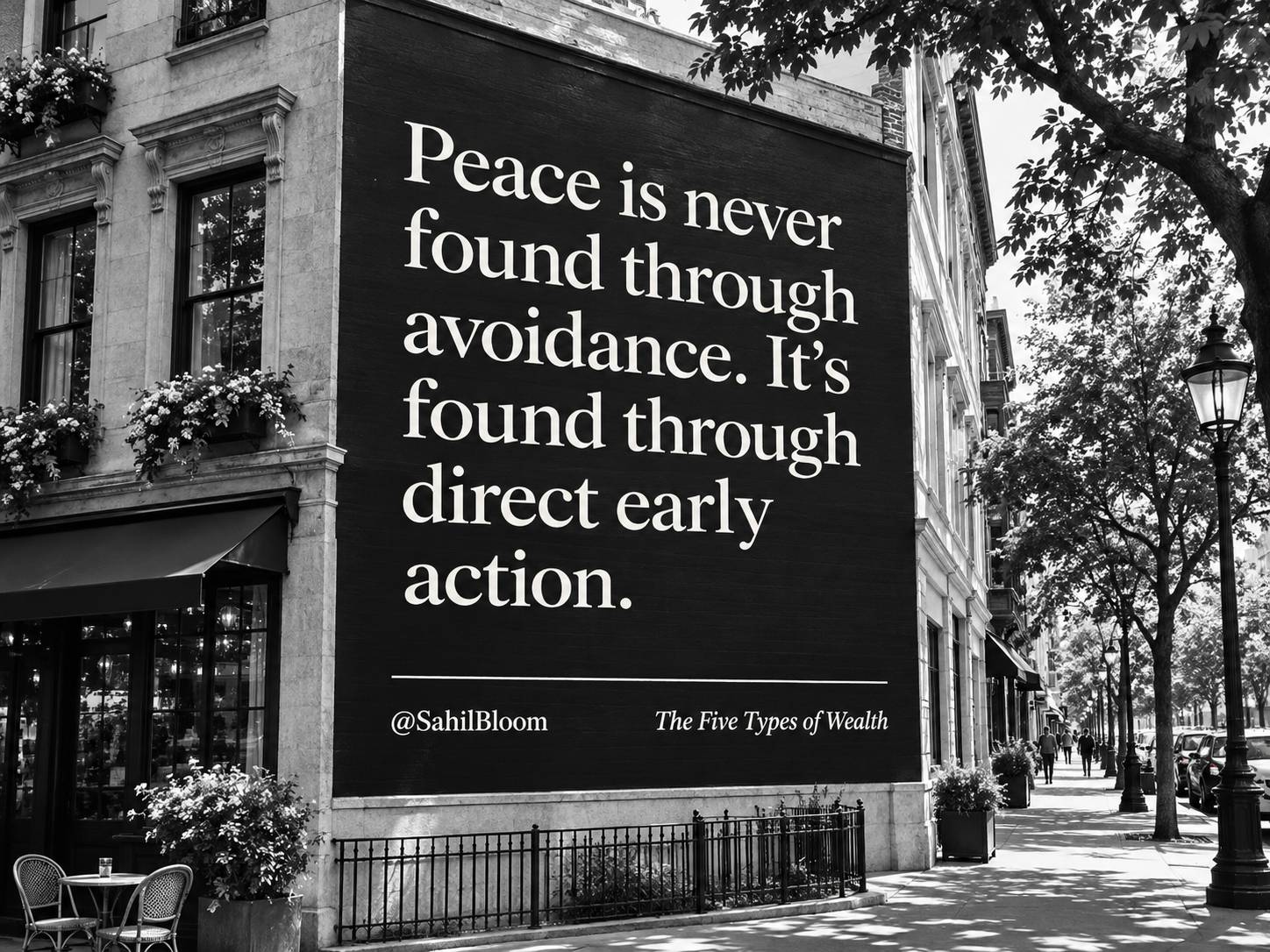
Peace is never found through avoidance. It's found through direct early action.