Click Here
Cart

Order the instant New York Times bestseller: The 5 Types of Wealth

Order My NYT Bestselling Book

How to Break Your Phone Addiction (3 Painfully Simple Steps)

Sahil Bloom

Welcome to the 242 new members of the curiosity tribe who have joined us since Wednesday. Join the 57,887 others who are receiving high-signal, curiosity-inducing content every single week.

What’s a Rich Text element?

The rich text element allows you to create and format headings, paragraphs, blockquotes, images, and video all in one place instead of having to add and format them individually. Just double-click and easily create content.

Static and dynamic content editing

A rich text element can be used with static or dynamic content. For static content,

just drop it into any page and begin editing. For dynamic content, add a rich text field to any collection and then connect a rich text element to that field in the settings panel. Voila!

  • mldsa
  • ,l;cd
  • mkclds

How to customize formatting for each rich text

Headings, paragraphs, blockquotes, figures, images, and figure captions can all be styled after a class is added to the rich text element using the "When inside of"

nested selector

system.

Six weeks ago, I shared ​an embarrassing confession​ on my phone addiction.

It all began at my ​Think Week​ retreat in January, when I pondered a single question:

If you were the main character in a movie of your life, what would the audience be screaming at you to do right now?

The answer, in this case, felt blindingly obvious:

Get off the damn phone.

I realized that everything I wanted to achieve in my personal and professional life seemed like a natural downstream consequence of spending less time on my phone:

  • More connected relationships with my wife, son, and family.
  • Deep, higher quality output on my most important projects.
  • Improved balance and day-to-day happiness.

So, I decided to do something about it.

I created a plan to break my phone addiction in 30 days—and I wrote about that plan in this newsletter. Thousands of you replied with positive responses, many declaring an intention or desire to do the same.

But plans are nothing without execution. The world is filled with half-kept promises and unfulfilled intentions.

You get the cheap dopamine hit from declaring your plan publicly—and then do precisely nothing to follow through on it.

So, in the interest of full transparency, today, I'm proud to share the receipts:

  • The results of the phone addiction intervention
  • The tangible impact and ripple effects in my life
  • The specific tactics that worked (that you can steal and apply today)

Let's dive into it...

The Results

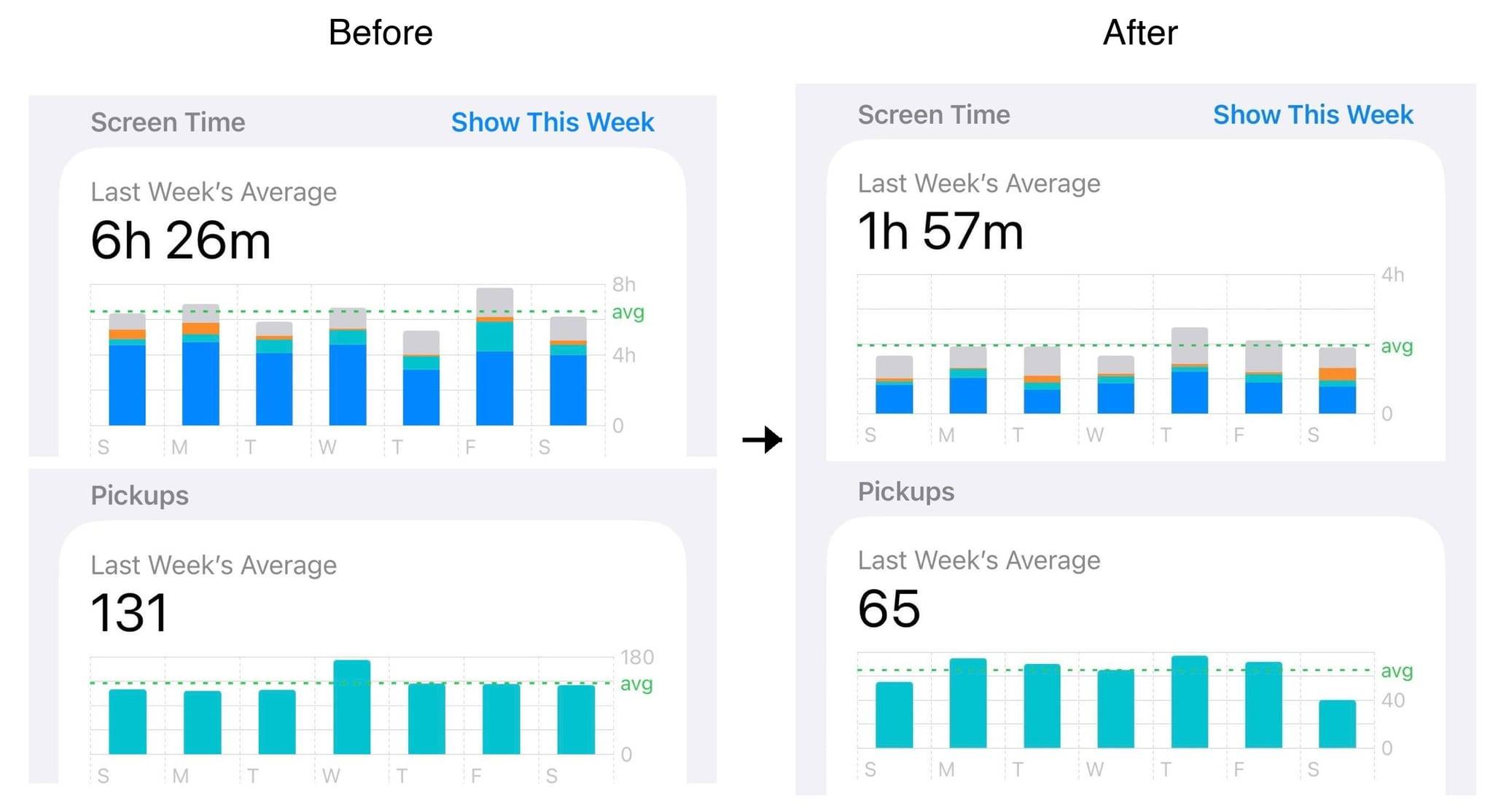
The before-and-after of my phone use data tells the entire story:

  • Screen Time was down ~70%
  • Pickups were down ~50%

Those numbers are even more striking when you aggregate them across a month or a year.

At the "after" levels, I get back ~134 hours each month.

That's nearly 6 days of awake hours that are no longer spent looking at my phone.

Play that out over a year and you get ~1,635 hours.

That's 68 days of life reclaimed from a single behavior change.

My mind is blown...

The Life Impact

I'm not going to sugarcoat it at all:

This was the single most powerful behavior change I've ever made in terms of the tangible impact and ripple effects on my life.

That is not an exaggeration. I'll break it down across three major areas:

Family & Relationships

I didn't tell my extended family that I was making this change. Only my wife knew. But within two weeks, I had received multiple comments from family members—including my mom and in-laws—about my perceived presence, happiness, and lower stress levels.

In each case, they assumed that something was going well in my work or life. And in each case, I informed them that it was much simpler than that:

I just didn't have my phone on me!

My wife said she noticed an immediate impact in how attentive I was being with her. My time with my son felt much more engaged and vibrant.

I was more present, less stressed, and able to connect on an entirely different level. In short, I showed up more aligned with how my ideal self would.

Work

My capacity for deep work expanded significantly from simply placing my phone in another room or a lock box.

Reviewing the research, this isn't surprising:

There is clear ​scientific evidence​ that even having your phone in your pocket or on your desk reduces your cognitive capacity.

Source: UChicago Study

I got more done, faster, at a higher quality bar. It was like the holy trinity of productivity improvement, with no fancy productivity tool required.

Overall Happiness

I felt happier and less stressed immediately upon making the change.

I believe the two biggest drivers of this were:

  1. Improved Compartmentalization: When I was on my phone, it was for a clear, value-add purpose. When I was off my phone, I was focused on the work or people in front of me. The clear lines replaced the blurred ones from my life prior to the intervention.
  2. Less Exposure to Negativity: The size of my platform exposes me to a lot of direct negativity on social media (and occasionally via rude emails). Also, the more time you spend on social media, ​the darker your perception of reality becomes​. Reduced time on social media meant reduced exposure to all forms of negativity.

So, just keeping score...

This was a single, zero cost behavior change that had the net effect of:

  • Improving my relationships
  • Improving my work
  • Improving my happiness

To be completely transparent, just a few days in, the only negative thought I had related to the intervention was simple:

Why didn't I do this sooner?

The Specific Tactics

Ok, hopefully I've convinced you that this is something you can and should do.

Now for the guide on how to do it. Please share and steal this.

I tried a bunch of things as part of this phone addiction intervention. Here's exactly what worked:

1. Grayscale Mode

Put your phone on Grayscale Mode for the entire day.

Grayscale Mode removes the colors to make your phone immediately less appealing and addicting.
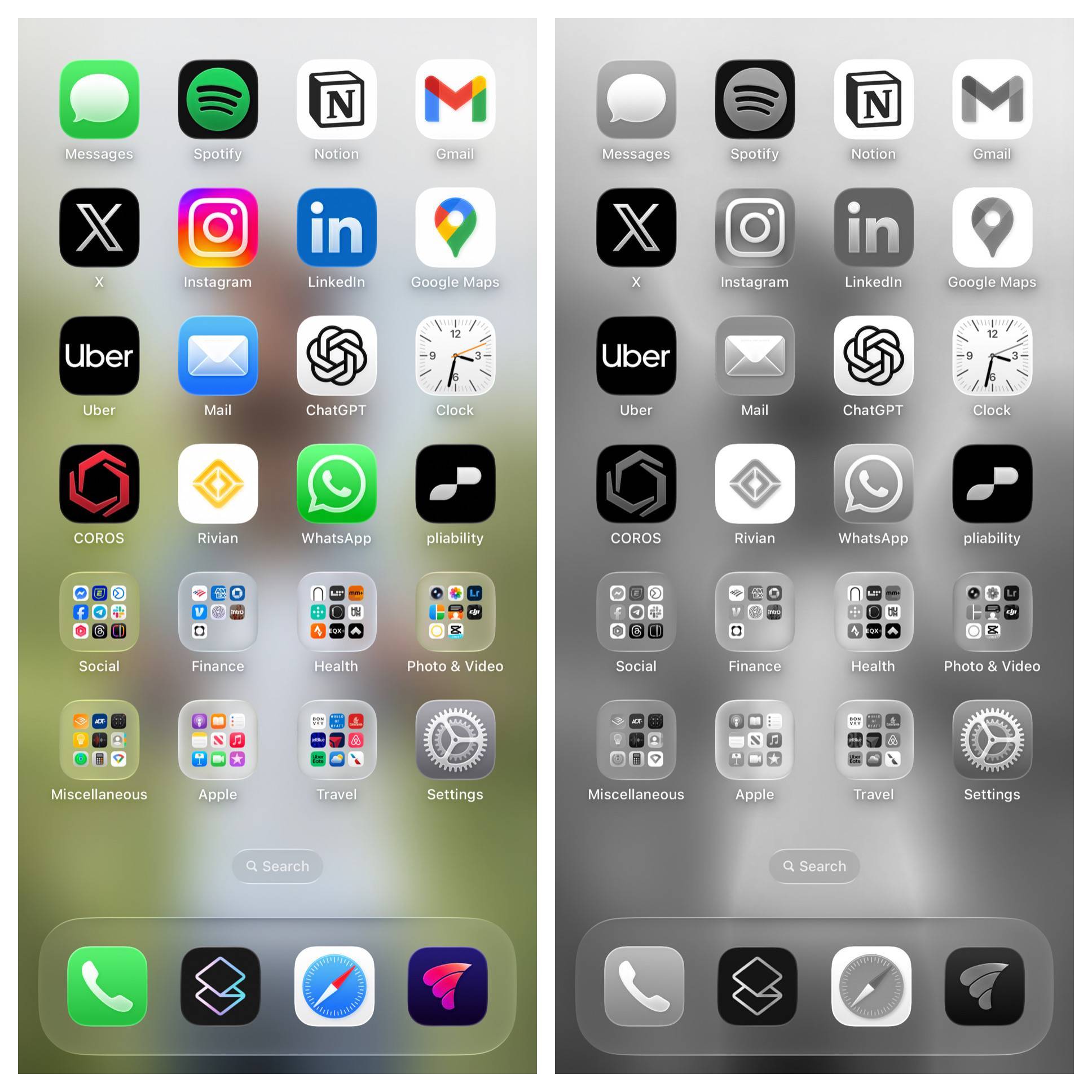
It takes 30 seconds to set up.

If you have an iPhone, follow these steps:

Next, create a simple shortcut:

Now, if you triple-click the side button, you'll be able to toggle it on and off.

For non-iPhone users, you can find instructions ​here​ (or with a simple search).

I kept my phone on Grayscale at all times and only removed it for specific reasons (like posting something that required me to see the color, looking at photos, etc.). It made me less interested in grabbing my phone for the random "just checks" during the day.

2. No-Phone Zones

Set specific locations, times, and events where you won't have your phone on you.

I called them No-Phone Zones:

  • Downstairs (kitchen, living room, basement, playroom)
  • Creative flow time (mornings from ~5-8am)
  • Family flow time (evenings from ~5-7pm)
  • Family gatherings

During these windows, my phone would be in a lock box or in a drawer in my office. If we were out at a family gathering, I would leave it in the car or in my wife's bag where I couldn't feel it.

Specifically listing out these No-Phone Zones had the benefit of making it a clear rule that I could cement in my mind.

Create your list of No-Phone Zones. Write it down if you need to.

3. Strategic Friction

Even with the Grayscale Mode and No-Phone Zones, my phone addiction intervention would have been difficult to execute without this final piece of the puzzle.

Motivation and discipline are never enough when you're trying to crack a deeply entrenched behavior.

There's a theory in cognitive science called Choice Architecture, which is the idea that you can design your environment to make good choices easier and bad choices harder.

Basically, I wanted to add strategic friction to make it much easier to adhere to my rules (and much more difficult to break them).

Three primary ways I did that:

  1. I locked my phone in a ​lock box​ during my morning creative flow (5-8am) and evening family flow (5-7pm). It was a timed lock so I couldn’t get it without emailing the company.
  2. I left my phone far away from where I was going to be working. If I wanted to get it, I'd have to walk to the other side of the house or down a few flights of stairs to get it.
  3. I added really low screen time restrictions to social apps. If I wanted to overuse them, I'd have to keep approving more time, which felt like letting myself down when I did it.

Breaking the addiction is going to be difficult at first. Create strategic friction that helps you stick to the change. Make it difficult to make a bad choice.

Why Didn't I Do This Sooner?

I should mention that there were a few things that gave me trouble (or that didn't really stick):

  1. Digital Sabbath: I attempted to do a full no phone day once per week. It was logistically very challenging given it tended to coincide with a family outing when I needed my phone for a variety of reasons (safety, photos, etc.). I’ll continue to experiment with this, but found the Digital Sabbath largely unnecessary when my daily use was down to a much lower baseline level.
  2. Travel Days: Some of the worst setbacks were during my travel days to and from various speaking engagements. Stuck in airports during delays, sitting in Ubers, etc. My default setting to grab the phone was really highlighted during these periods.
  3. Overcorrection Stress: This was an interesting one. I started to feel a pang of stress when I'd need to use my phone, knowing that I was trying to reduce my screen time. The metric of screen time became a minor obsession, so even legitimate uses (like booking an alternative flight during a bad delay) felt painful. It was bizarre, but worth noting as something you might experience if you're wired like me.
  4. Gym Sessions: I'm still working on how to reduce my phone usage during my workouts. I tend to check my phone in between sets during my rest intervals.

Taken all together, I really meant what I wrote earlier in the piece:

Why didn't I do this sooner?

I was correct in my belief that everything I wanted to improve in my life was downstream from spending less time on my phone. I've seen it. I've felt the impact. Now I just want to compound it.

In the coming months, I'm going to attempt to push my screen time even lower to see if there are diminishing returns to further reductions.

Note: If you're interested in further updates on those experiments, just reply YES to this email.

I hope this piece is the push you need to make this change in your life. Start small and stick to it. Aim for a 10-20% screen time reduction week-over-week. Keep yourself accountable with a friend (or email me your progress).

Having now gone through it, I can guarantee you'll see and feel the positive impact immediately.

Onward and upward.

How to Break Your Phone Addiction (3 Painfully Simple Steps)

Sahil Bloom

Welcome to the 242 new members of the curiosity tribe who have joined us since Wednesday. Join the 57,887 others who are receiving high-signal, curiosity-inducing content every single week.

What’s a Rich Text element?

The rich text element allows you to create and format headings, paragraphs, blockquotes, images, and video all in one place instead of having to add and format them individually. Just double-click and easily create content.

Static and dynamic content editing

A rich text element can be used with static or dynamic content. For static content,

just drop it into any page and begin editing. For dynamic content, add a rich text field to any collection and then connect a rich text element to that field in the settings panel. Voila!

  • mldsa
  • ,l;cd
  • mkclds

How to customize formatting for each rich text

Headings, paragraphs, blockquotes, figures, images, and figure captions can all be styled after a class is added to the rich text element using the "When inside of"

nested selector

system.

Six weeks ago, I shared ​an embarrassing confession​ on my phone addiction.

It all began at my ​Think Week​ retreat in January, when I pondered a single question:

If you were the main character in a movie of your life, what would the audience be screaming at you to do right now?

The answer, in this case, felt blindingly obvious:

Get off the damn phone.

I realized that everything I wanted to achieve in my personal and professional life seemed like a natural downstream consequence of spending less time on my phone:

  • More connected relationships with my wife, son, and family.
  • Deep, higher quality output on my most important projects.
  • Improved balance and day-to-day happiness.

So, I decided to do something about it.

I created a plan to break my phone addiction in 30 days—and I wrote about that plan in this newsletter. Thousands of you replied with positive responses, many declaring an intention or desire to do the same.

But plans are nothing without execution. The world is filled with half-kept promises and unfulfilled intentions.

You get the cheap dopamine hit from declaring your plan publicly—and then do precisely nothing to follow through on it.

So, in the interest of full transparency, today, I'm proud to share the receipts:

  • The results of the phone addiction intervention
  • The tangible impact and ripple effects in my life
  • The specific tactics that worked (that you can steal and apply today)

Let's dive into it...

The Results

The before-and-after of my phone use data tells the entire story:

  • Screen Time was down ~70%
  • Pickups were down ~50%

Those numbers are even more striking when you aggregate them across a month or a year.

At the "after" levels, I get back ~134 hours each month.

That's nearly 6 days of awake hours that are no longer spent looking at my phone.

Play that out over a year and you get ~1,635 hours.

That's 68 days of life reclaimed from a single behavior change.

My mind is blown...

The Life Impact

I'm not going to sugarcoat it at all:

This was the single most powerful behavior change I've ever made in terms of the tangible impact and ripple effects on my life.

That is not an exaggeration. I'll break it down across three major areas:

Family & Relationships

I didn't tell my extended family that I was making this change. Only my wife knew. But within two weeks, I had received multiple comments from family members—including my mom and in-laws—about my perceived presence, happiness, and lower stress levels.

In each case, they assumed that something was going well in my work or life. And in each case, I informed them that it was much simpler than that:

I just didn't have my phone on me!

My wife said she noticed an immediate impact in how attentive I was being with her. My time with my son felt much more engaged and vibrant.

I was more present, less stressed, and able to connect on an entirely different level. In short, I showed up more aligned with how my ideal self would.

Work

My capacity for deep work expanded significantly from simply placing my phone in another room or a lock box.

Reviewing the research, this isn't surprising:

There is clear ​scientific evidence​ that even having your phone in your pocket or on your desk reduces your cognitive capacity.

Source: UChicago Study

I got more done, faster, at a higher quality bar. It was like the holy trinity of productivity improvement, with no fancy productivity tool required.

Overall Happiness

I felt happier and less stressed immediately upon making the change.

I believe the two biggest drivers of this were:

  1. Improved Compartmentalization: When I was on my phone, it was for a clear, value-add purpose. When I was off my phone, I was focused on the work or people in front of me. The clear lines replaced the blurred ones from my life prior to the intervention.
  2. Less Exposure to Negativity: The size of my platform exposes me to a lot of direct negativity on social media (and occasionally via rude emails). Also, the more time you spend on social media, ​the darker your perception of reality becomes​. Reduced time on social media meant reduced exposure to all forms of negativity.

So, just keeping score...

This was a single, zero cost behavior change that had the net effect of:

  • Improving my relationships
  • Improving my work
  • Improving my happiness

To be completely transparent, just a few days in, the only negative thought I had related to the intervention was simple:

Why didn't I do this sooner?

The Specific Tactics

Ok, hopefully I've convinced you that this is something you can and should do.

Now for the guide on how to do it. Please share and steal this.

I tried a bunch of things as part of this phone addiction intervention. Here's exactly what worked:

1. Grayscale Mode

Put your phone on Grayscale Mode for the entire day.

Grayscale Mode removes the colors to make your phone immediately less appealing and addicting.

It takes 30 seconds to set up.

If you have an iPhone, follow these steps:

Next, create a simple shortcut:

Now, if you triple-click the side button, you'll be able to toggle it on and off.

For non-iPhone users, you can find instructions ​here​ (or with a simple search).

I kept my phone on Grayscale at all times and only removed it for specific reasons (like posting something that required me to see the color, looking at photos, etc.). It made me less interested in grabbing my phone for the random "just checks" during the day.

2. No-Phone Zones

Set specific locations, times, and events where you won't have your phone on you.

I called them No-Phone Zones:

  • Downstairs (kitchen, living room, basement, playroom)
  • Creative flow time (mornings from ~5-8am)
  • Family flow time (evenings from ~5-7pm)
  • Family gatherings

During these windows, my phone would be in a lock box or in a drawer in my office. If we were out at a family gathering, I would leave it in the car or in my wife's bag where I couldn't feel it.

Specifically listing out these No-Phone Zones had the benefit of making it a clear rule that I could cement in my mind.

Create your list of No-Phone Zones. Write it down if you need to.

3. Strategic Friction

Even with the Grayscale Mode and No-Phone Zones, my phone addiction intervention would have been difficult to execute without this final piece of the puzzle.

Motivation and discipline are never enough when you're trying to crack a deeply entrenched behavior.

There's a theory in cognitive science called Choice Architecture, which is the idea that you can design your environment to make good choices easier and bad choices harder.

Basically, I wanted to add strategic friction to make it much easier to adhere to my rules (and much more difficult to break them).

Three primary ways I did that:

  1. I locked my phone in a ​lock box​ during my morning creative flow (5-8am) and evening family flow (5-7pm). It was a timed lock so I couldn’t get it without emailing the company.
  2. I left my phone far away from where I was going to be working. If I wanted to get it, I'd have to walk to the other side of the house or down a few flights of stairs to get it.
  3. I added really low screen time restrictions to social apps. If I wanted to overuse them, I'd have to keep approving more time, which felt like letting myself down when I did it.

Breaking the addiction is going to be difficult at first. Create strategic friction that helps you stick to the change. Make it difficult to make a bad choice.

Why Didn't I Do This Sooner?

I should mention that there were a few things that gave me trouble (or that didn't really stick):

  1. Digital Sabbath: I attempted to do a full no phone day once per week. It was logistically very challenging given it tended to coincide with a family outing when I needed my phone for a variety of reasons (safety, photos, etc.). I’ll continue to experiment with this, but found the Digital Sabbath largely unnecessary when my daily use was down to a much lower baseline level.
  2. Travel Days: Some of the worst setbacks were during my travel days to and from various speaking engagements. Stuck in airports during delays, sitting in Ubers, etc. My default setting to grab the phone was really highlighted during these periods.
  3. Overcorrection Stress: This was an interesting one. I started to feel a pang of stress when I'd need to use my phone, knowing that I was trying to reduce my screen time. The metric of screen time became a minor obsession, so even legitimate uses (like booking an alternative flight during a bad delay) felt painful. It was bizarre, but worth noting as something you might experience if you're wired like me.
  4. Gym Sessions: I'm still working on how to reduce my phone usage during my workouts. I tend to check my phone in between sets during my rest intervals.

Taken all together, I really meant what I wrote earlier in the piece:

Why didn't I do this sooner?

I was correct in my belief that everything I wanted to improve in my life was downstream from spending less time on my phone. I've seen it. I've felt the impact. Now I just want to compound it.

In the coming months, I'm going to attempt to push my screen time even lower to see if there are diminishing returns to further reductions.

Note: If you're interested in further updates on those experiments, just reply YES to this email.

I hope this piece is the push you need to make this change in your life. Start small and stick to it. Aim for a 10-20% screen time reduction week-over-week. Keep yourself accountable with a friend (or email me your progress).

Having now gone through it, I can guarantee you'll see and feel the positive impact immediately.

Onward and upward.