


The Hidden Cost of Ambivalent Relationships

Today at a Glance
What’s a Rich Text element?
The rich text element allows you to create and format headings, paragraphs, blockquotes, images, and video all in one place instead of having to add and format them individually. Just double-click and easily create content.
Static and dynamic content editing
A rich text element can be used with static or dynamic content. For static content, just drop it into any page and begin editing. For dynamic content, add a rich text field to any collection and then connect a rich text element to that field in the settings panel. !
- ml;xsml;xa
- koxsaml;xsml;xsa
- mklxsaml;xsa
How to customize formatting for each rich text
Headings, paragraphs, blockquotes, figures, images, and figure captions can all be styled after a class is added to the rich text element using the "When inside of" nested selector system.
I read an interesting study a few years ago that fundamentally changed the way I think about relationships.
Researchers wanted to examine how different types of social relationships affected long-term health outcomes.
They categorized relationships into three buckets:
- Supportive: Consistently positive
- Demeaning: Consistently negative
- Ambivalent: Sometimes supportive, sometimes demeaning
The researchers specifically wanted to look at the impact of ambivalent relationships on wellbeing.
104 healthy young adults were asked to bring a friend to the lab and characterize the relationship as either supportive or ambivalent.
Each participant had to deliver an impromptu speech in front of the group (a high pressure task designed to trigger a stress response) and receive feedback from the friend they brought.
The friend's feedback on the speech was randomly assigned by the researchers as positive, negative, ambivalent, or ambiguous.
The participants had a series of cardiovascular measurements taken before, during, and after the speech—including heart rate and blood pressure.
The findings were fascinating:
The participants who had self-identified the relationship with the friend as ambivalent had higher blood pressure response, higher anxiety, and higher heart rate reactivity.
Most importantly, that effect remained even when the ambivalent friend gave positive feedback.
In other words, the ambivalent nature of the relationship was creating a negative physical response, independent of the treatment in the moment.
Here's the critical lesson most of us miss:
Your body and nervous system are anticipatory. When a relationship is unpredictable—sometimes good, sometimes bad—your physical systems never stand down. They stay alert. On edge. Guarded.
The constant, low-grade vigilance takes its toll over a long time horizon.
As psychologist and bestselling author Adam Grant wrote in a NYT op-ed:
"The most toxic relationships aren’t the purely negative ones. They’re the ones that are a mix of positive and negative."
So, what can you do about it?
I recommend starting your year with an exercise from my book that I call the Relationship Map.
Place your core relationships on a simple 2x2 grid:
- Relationship Health on the X-axis (from demeaning to supportive)
- Relationship Frequency on the Y-axis (from rare to daily)
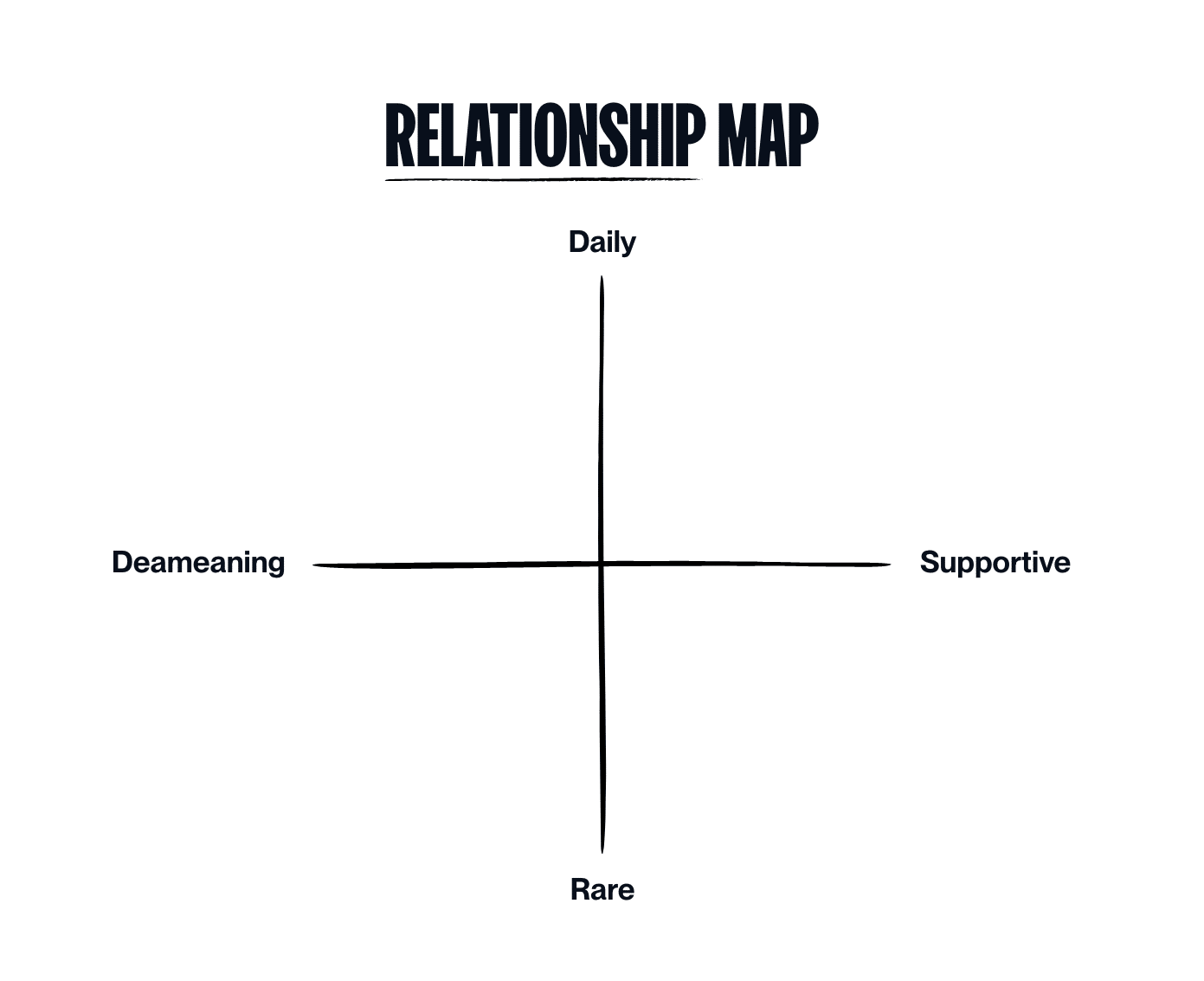
The purpose of the mapping exercise is to identify four zones:
- Green Zone: High support, high frequency.
- Opportunity Zone: High support, low frequency.
- Red Zone: Demeaning, high frequency.
- Danger Zone: Ambivalent, high frequency.
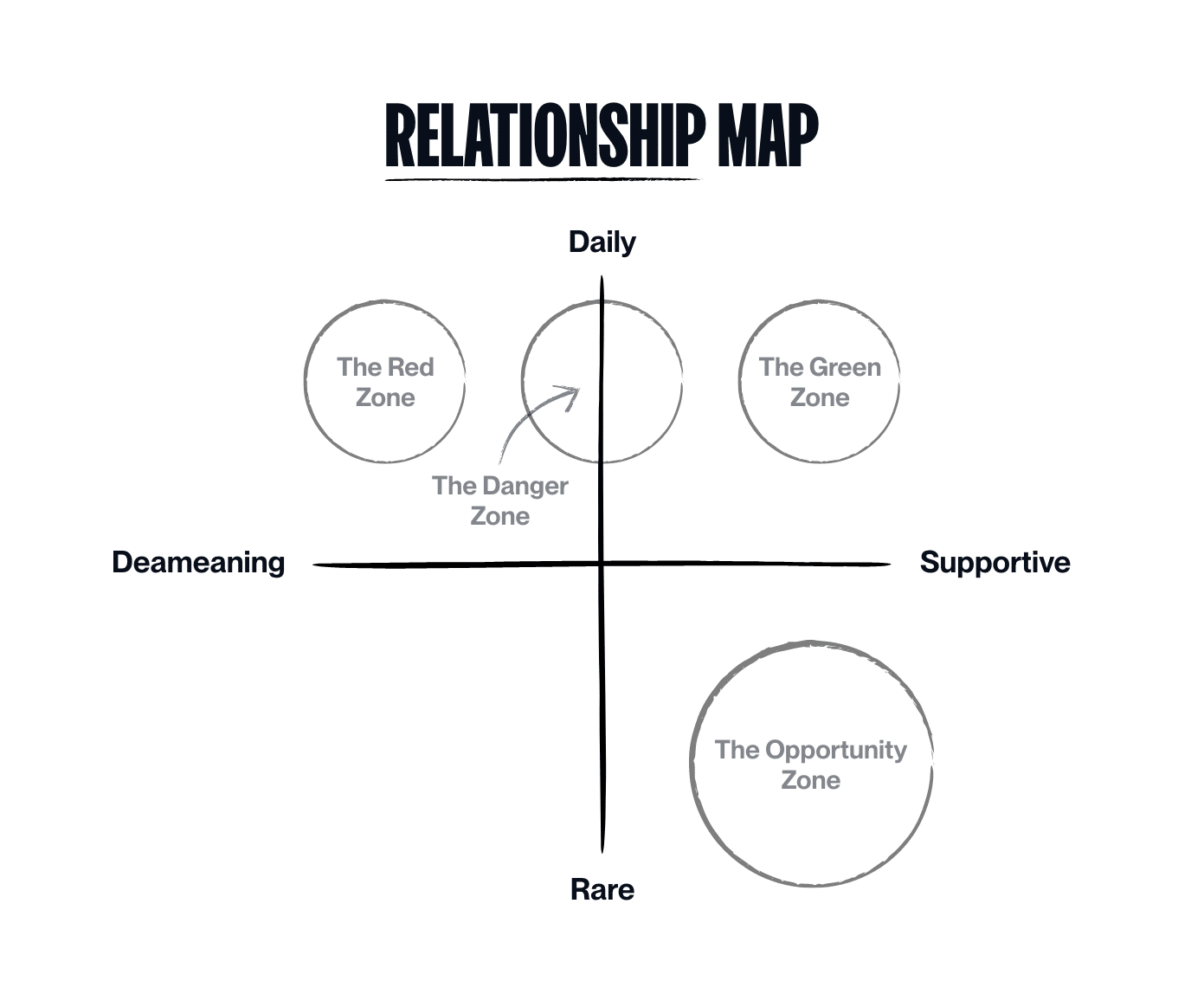
With the completed map in hand, you can focus your energy in 2026 on the right people.
Lean into the Green Zone and Opportunity Zone relationships. These people lift you up. Lean away from the Red Zone relationships. These people drag you down.
And as the study showed, beware the Danger Zone relationships. Communicate actively in an attempt to improve them. But if the unpredictability continues, don't be afraid to minimize the energy you give to these people.
There is clear scientific evidence that the quality of your relationships may be the single most important predictor of your long term health and wellbeing.
Choose your people wisely.


