Click Here
Cart

Order the instant New York Times bestseller: The 5 Types of Wealth

Order My NYT Bestselling Book

The False Timelines of Life

Sahil Bloom

Welcome to the 242 new members of the curiosity tribe who have joined us since Wednesday. Join the 57,887 others who are receiving high-signal, curiosity-inducing content every single week.

What’s a Rich Text element?

The rich text element allows you to create and format headings, paragraphs, blockquotes, images, and video all in one place instead of having to add and format them individually. Just double-click and easily create content.

Static and dynamic content editing

A rich text element can be used with static or dynamic content. For static content,

just drop it into any page and begin editing. For dynamic content, add a rich text field to any collection and then connect a rich text element to that field in the settings panel. Voila!

  • mldsa
  • ,l;cd
  • mkclds

How to customize formatting for each rich text

Headings, paragraphs, blockquotes, figures, images, and figure captions can all be styled after a class is added to the rich text element using the "When inside of"

nested selector

system.

Today is my 35th birthday.

I want to open up about something personal. Something that will resonate with a lot of you.

It's about timelines. More specifically, the false timelines of life.

For all of my 20s, my birthday wasn't something I looked forward to. It was anxiety-inducing. It carried the heavy psychological weight of missed expectations.

Another year older. Another checkpoint missed. Another reminder that I wasn't where I was supposed to be.

On my 28th birthday, I vividly remember driving to the gym before work and feeling a panic attack rising as I momentarily forgot how old I was turning that day.

I thought to myself, Oh my god, I'll be 30 next year and I haven't accomplished anything. I've gotta get going.

Then, I remembered I was turning 28 (not 29) and had two years to figure it out. The panic dissipated. Temporarily.

As I consumed a steady diet of highlight reels on LinkedIn and social media, I became fixated with being on track.

I watched as people my age (or younger) raised massive funding rounds, landed prestigious titles, announced promotions (they were always "humbled and honored" to do so), and built impressive companies.

I needed to get the external markers that would prove I was doing life correctly. To others, sure, but maybe more importantly, to myself.

One such marker was the infamous Forbes 30 Under 30 list. It's embarrassing to admit, but I was obsessed with getting on that. I told myself it didn't matter. That it was superficial. That it was a pay-for-play. But privately, I longed for the stamp of approval. The evidence that I was worthy. That I was impressive. That I hadn't fallen behind.

That I was on track.

I assumed the timelines I was chasing were correct—and that I was the thing that was broken.

If I felt behind, it must be because I wasn't working hard enough. If I felt anxious, it must be because I wasn't good enough. If I lacked purpose, it must be because I was broken.

Those timelines had a corrosive impact on my life. They created a low-grade sense of self-loathing that nothing seemed to quiet.

Looking back on the last 15 years, I can see my relationship with these timelines in phases:

  • At 20, I learned the timeline.
  • At 25, I became obsessed with keeping up with it.
  • At 30, I made myself miserable trying to force my life to conform to it.

And now, at 35, I finally see the truth I was blind to for all those years:

There is no universal timeline for a meaningful life.

There is no fixed age by which you must have it figured out. There is no master schedule for success, purpose, love, or fulfillment. No external scoreboard keeping track of who's ahead and who's behind.

There's just you. Your life. Your path. And what you choose to do with it.

The great lie of these timelines is that they pretend life is linear and uniform. In reality, it's uneven and deeply individual.

So, let this piece be your sign:

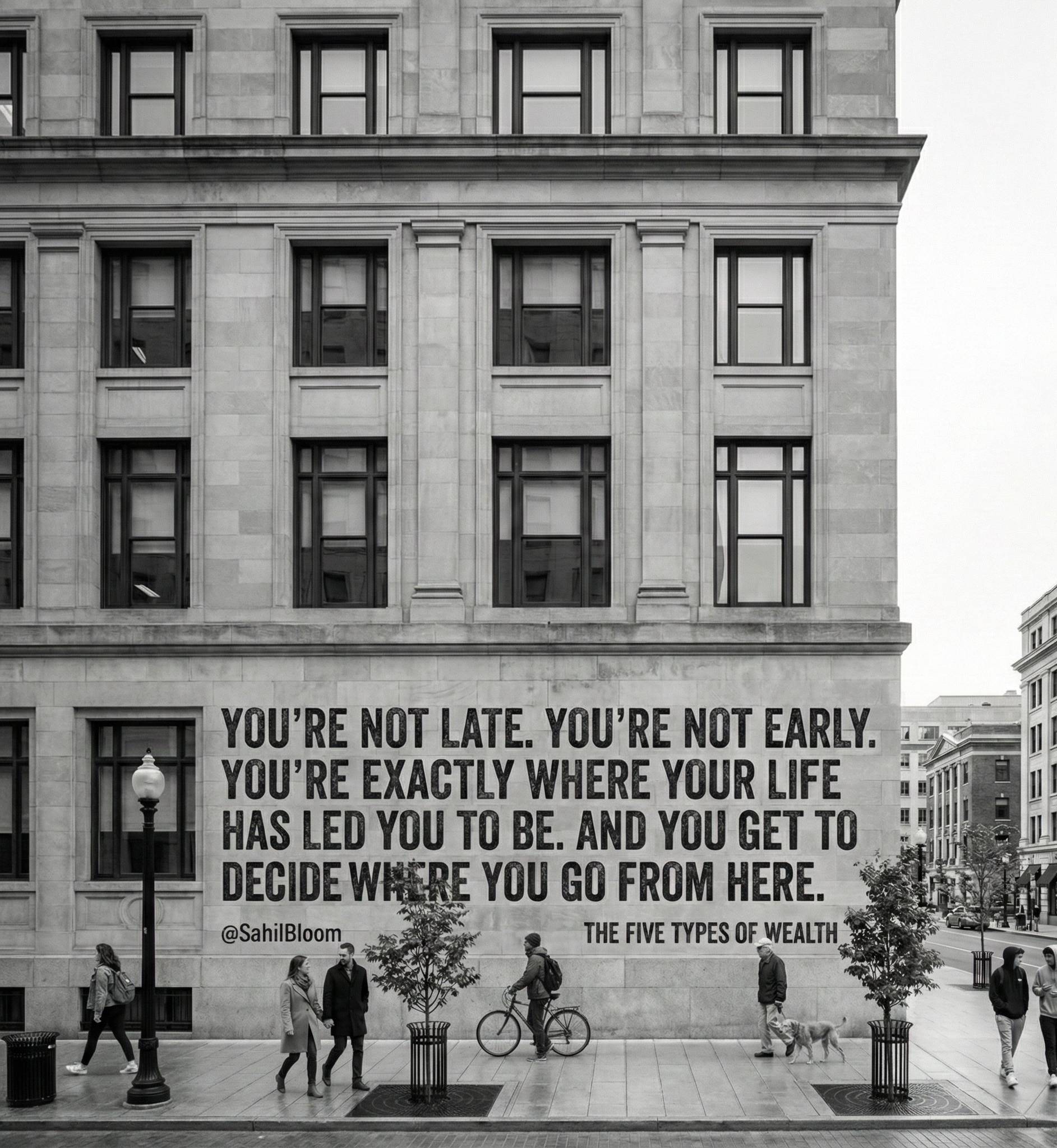
You're not late. You're not early. You're exactly where your life has led you to be. And you get to decide where you go from here.

Take it from me—a proud 10-time Forbes 30 Under 30 Rejectee—you can miss every arbitrary timeline and still build a life you love.

Onward and upward.

- Sahil
The False Timelines of Life

Sahil Bloom

Welcome to the 242 new members of the curiosity tribe who have joined us since Wednesday. Join the 57,887 others who are receiving high-signal, curiosity-inducing content every single week.

What’s a Rich Text element?

The rich text element allows you to create and format headings, paragraphs, blockquotes, images, and video all in one place instead of having to add and format them individually. Just double-click and easily create content.

Static and dynamic content editing

A rich text element can be used with static or dynamic content. For static content,

just drop it into any page and begin editing. For dynamic content, add a rich text field to any collection and then connect a rich text element to that field in the settings panel. Voila!

  • mldsa
  • ,l;cd
  • mkclds

How to customize formatting for each rich text

Headings, paragraphs, blockquotes, figures, images, and figure captions can all be styled after a class is added to the rich text element using the "When inside of"

nested selector

system.

Today is my 35th birthday.

I want to open up about something personal. Something that will resonate with a lot of you.

It's about timelines. More specifically, the false timelines of life.

For all of my 20s, my birthday wasn't something I looked forward to. It was anxiety-inducing. It carried the heavy psychological weight of missed expectations.

Another year older. Another checkpoint missed. Another reminder that I wasn't where I was supposed to be.

On my 28th birthday, I vividly remember driving to the gym before work and feeling a panic attack rising as I momentarily forgot how old I was turning that day.

I thought to myself, Oh my god, I'll be 30 next year and I haven't accomplished anything. I've gotta get going.

Then, I remembered I was turning 28 (not 29) and had two years to figure it out. The panic dissipated. Temporarily.

As I consumed a steady diet of highlight reels on LinkedIn and social media, I became fixated with being on track.

I watched as people my age (or younger) raised massive funding rounds, landed prestigious titles, announced promotions (they were always "humbled and honored" to do so), and built impressive companies.

I needed to get the external markers that would prove I was doing life correctly. To others, sure, but maybe more importantly, to myself.

One such marker was the infamous Forbes 30 Under 30 list. It's embarrassing to admit, but I was obsessed with getting on that. I told myself it didn't matter. That it was superficial. That it was a pay-for-play. But privately, I longed for the stamp of approval. The evidence that I was worthy. That I was impressive. That I hadn't fallen behind.

That I was on track.

I assumed the timelines I was chasing were correct—and that I was the thing that was broken.

If I felt behind, it must be because I wasn't working hard enough. If I felt anxious, it must be because I wasn't good enough. If I lacked purpose, it must be because I was broken.

Those timelines had a corrosive impact on my life. They created a low-grade sense of self-loathing that nothing seemed to quiet.

Looking back on the last 15 years, I can see my relationship with these timelines in phases:

  • At 20, I learned the timeline.
  • At 25, I became obsessed with keeping up with it.
  • At 30, I made myself miserable trying to force my life to conform to it.

And now, at 35, I finally see the truth I was blind to for all those years:

There is no universal timeline for a meaningful life.

There is no fixed age by which you must have it figured out. There is no master schedule for success, purpose, love, or fulfillment. No external scoreboard keeping track of who's ahead and who's behind.

There's just you. Your life. Your path. And what you choose to do with it.

The great lie of these timelines is that they pretend life is linear and uniform. In reality, it's uneven and deeply individual.

So, let this piece be your sign:

You're not late. You're not early. You're exactly where your life has led you to be. And you get to decide where you go from here.

Take it from me—a proud 10-time Forbes 30 Under 30 Rejectee—you can miss every arbitrary timeline and still build a life you love.

Onward and upward.

- Sahil