Click Here
Cart

Order the instant New York Times bestseller: The 5 Types of Wealth

Order My NYT Bestselling Book

The Deathbed Regret List

Sahil Bloom

Welcome to the 242 new members of the curiosity tribe who have joined us since Wednesday. Join the 57,887 others who are receiving high-signal, curiosity-inducing content every single week.

What’s a Rich Text element?

The rich text element allows you to create and format headings, paragraphs, blockquotes, images, and video all in one place instead of having to add and format them individually. Just double-click and easily create content.

Static and dynamic content editing

A rich text element can be used with static or dynamic content. For static content,

just drop it into any page and begin editing. For dynamic content, add a rich text field to any collection and then connect a rich text element to that field in the settings panel. Voila!

  • mldsa
  • ,l;cd
  • mkclds

How to customize formatting for each rich text

Headings, paragraphs, blockquotes, figures, images, and figure captions can all be styled after a class is added to the rich text element using the "When inside of"

nested selector

system.

"If you do not change direction, you may end up where you are heading." – Lao Tzu

In 1888, Alfred Nobel was best known as the inventor of dynamite. He had been issued over 300 patents and his business had built more than 50 explosives and armament factories all across Europe.

That year, while traveling in Cannes, France, Nobel's brother, Ludvig, suddenly died of a heart attack.

A French newspaper misreported the incident, penning an article that claimed Nobel himself had died:

"A man who can only with the utmost difficulty be considered a benefactor of mankind has died yesterday at Cannes. It is Mr. Nobel, inventor of dynamite."

Some sources even suggest an obituary ran with the unflattering headline "The Merchant of Death is Dead."

Reading the false reports of his own death, Alfred Nobel was shocked at what the world clearly thought of him. Determined to alter his legacy, he rewrote his will, giving 94% of his assets to establish The Nobel Prizes, which would be awarded annually for exceptional contributions to humanity in physics, chemistry, physiology or medicine, literature, and peace.

Alfred Nobel got something almost nobody gets: A clear preview of his destined future while he still had time to change it.

He saw something he knew he'd regret—so he did something about it.

Today, I want to share a simple exercise to help you do the same:

I call it the Deathbed Regret List.

(I know it sounds morbid, but I promise, it's not.)

The exercise is simple:

  1. Envision yourself on your deathbed.
  2. Make a list of the things you know you'd regret in that moment.
  3. Reverse engineer the actions and changes you need to make today to avoid experiencing those regrets.

If you find it difficult to envision yourself too far into the future, try using a 10 year time horizon, as it may make the exercise feel more tangible.

Here's the list I created (and what I'm doing to avoid them):

1. Leaving my family without financial security.

I've watched people achieve incredible success but lose sleep every night because they know one bad break could unravel it all.

Imagine your life as a skyscraper. You can't build a big, tall, beautiful building without a strong, stable, deep foundation. A fancy building built on top of a shoddy foundation will collapse.

I refuse to put my family in that position.

To me, establishing financial security for your loved ones is the stable foundation off which everything else can be built.

The highest return I get in my financial portfolio is on the 12 months of emergency funds I keep in cash. Knowing you've created that security allows you to see and capitalize on exciting opportunities when they come.

I will make sure my financial foundation is strong before I build to higher heights.

2. Missing out on the Magic Years.

In ​my book​, I shared a chart of the amount of time we spend with our children over the course of our lives.
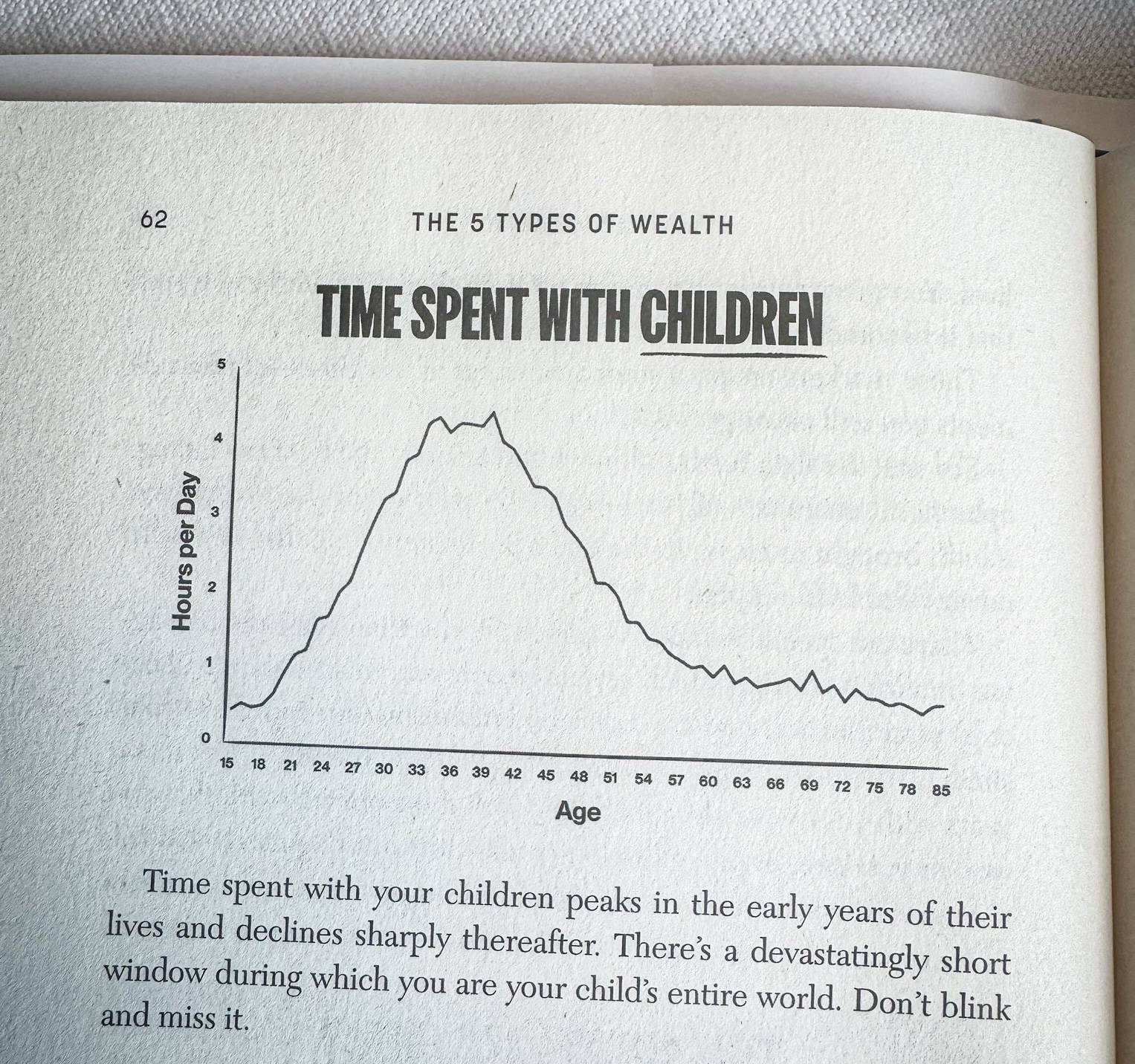
Source: The 5 Types of Wealth

Here's the harsh truth it shows:

By the time your child turns 18, you've spent ~95% of the time you will ever spend with them in your lifetime.

During those years, you are your child’s favorite person in the entire world. After that, they have other favorite people.

The “Magic Years” will fade away and disappear if you let them.

But you are in more control of your time than you realize. You can take actions to create time with the people you love most.

I won't allow my ambitions to destroy my presence during this precious window.

I will always remember to be there during the Magic Years.

3. Not spending enough time with my parents.

"You're going to see your parents 15 more times before they die."

In 2021, those simple words from an old friend changed my life.

Within 45 days, my wife and I took a dramatic action. We uprooted our life in California and moved back to the East Coast with the goal of living within driving distance of both sets of parents.

This past fall, we took another step, moving from New York to Boston, back to the old stomping grounds to be even closer.

I'm writing this on Friday evening. My parents are coming over to hang out shortly. They'll play with my son. We'll have dinner. I'll sauna with my dad.

I wish someone had told me sooner: Nothing improves quality of life more than proximity to people you love. It’s worth more than any job will ever pay you.

I will prioritize time with my parents during our remaining years.

4. Not having the courage to take the leap.

Nobody tells you this: Talent and intelligence are overrated.

Intelligent people are more likely to overthink, overplan, and overanalyze. They hide behind motion that doesn't create progress. They fear the judgment of others if they're proven wrong.

The truth is that talent and intelligence are abundant. Courage is not.

The people you admire are the ones who had the courage to act. They aren’t more talented than you. They aren’t smarter than you. They just took action when you didn’t.

I often wonder how many extraordinary people wasted their entire lives waiting for permission that never came.

Permission isn't granted. It's taken. You get to tap yourself in whenever you want. You can just do things.

I will give myself permission to do the thing.

5. Not taking on challenging quests.

A human needs a quest.

The least happy people I know are those who lack challenging quests in their lives.

It's tempting to pursue ease, but one thing I've come to learn: The easy life can quickly start to feel like the meaningless life.

There's nothing better than hard-earned progress. The struggle. The pain. The grit. The resilience. And then, the breakthrough. The knowledge that you paid the cost of entry to achieve the growth you went after.

Hard, meaningful quests are good for the soul.

It can be personal or professional. Learn a new skill. Start a side business. Travel to a new place with no plans. Take on a difficult physical endeavor.

Just do something hard.

I will always take on new challenges.

6. Allowing meaningful relationships to atrophy.

The Harvard Study of Adult Development followed the lives of ~2,000 people over the course of 85 years.

Its most powerful finding:

The single most important predictor of physical health at age 80 was relationship satisfaction at age 50.

And yet, relationships are the first thing we drop the ball on when life gets busy. You forget to send the text. The annual trip with old friends quietly dies. The coffee date with your sibling gets pushed to "next month" for six months straight.

But it's an avoidable fate:

Invest in your relationships daily. Let your people know you appreciate them. And be there during the tough times just as much as the good ones.

Everyone shows up to celebrate the wins. When times are warm and sunny, you'll never be short on company. But very few people show up in the dark.

When someone you love is struggling, show up.

I will always invest in my most meaningful relationships.

7. Allowing my "house" to deteriorate.

I once asked a 90-year-old man what advice he'd give to his younger self:

"Treat your body like a house you're going to have to live in for the next 70 years."

It hit me hard. Your body and mind are quite literally the "house" you're going to have to live in until the end of your days.

And yet, how often do you make decisions that treat that house like crap?

What's worse is that those decisions impact the people you love most. I can't think of anything I'd regret more than becoming a burden to the people around me because I didn't control the controllable when it came to my health.

Invest in your health. Build a solid foundation. Take the daily actions. Make the minor repairs along the way.

I will treat my house with reverence.

8. Allowing technology to destroy my presence.

Technology has created more connectedness than ever before, but it also makes you feel less connected to those right in front of you.

I've experienced ​the negatives of phone addiction​. And now, I've also seen the extraordinary ​benefits of eliminating it​.

It was a single, zero cost behavior change that had the net effect of:

  • Improving my relationships
  • Improving my work
  • Improving my happiness

A reminder I'm going to be giving myself regularly: Get off the damn phone.

I will never let technology separate me from the real world.

9. Losing sight of the beauty of enough.

During the summer of 2022, I was on a walk with my newborn son when an older man approached me.

He said:

"I remember standing here with my newborn. Well, she's 45 now. It goes by fast, cherish it."

The next morning, I woke up and brought my son into bed. My wife was still peacefully asleep. It was early, and the first glimmers of the spring sun were starting to slip through our bedroom window.​​

I looked down at my son, whose eyes were closed, a small, perfectly content smile on his lips.​

In that moment, I had a profound sensation:

I had arrived, but for the first time in my life, there was nothing more that I wanted.​​ This was enough.​​

As ambitious people, we spend most of our lives playing a game:

Everything we do is in anticipation of a future. When it comes, we just reset to the next one.

When I get [X], then I'll be happy:

  • "When I make partner..."
  • "When I get that house..."
  • "When I find that person..."
  • "When I hit that goal..."

It’s natural, but it’s a dangerous game. One that you will lose eventually.

We waste a lot of energy on past and future when present is all that’s guaranteed. We push for more, but really, we need to find our version of enough.

I will never let the quest for more distract me from the beauty of enough.

Always Minimize Your Future Regrets

Jeff Bezos famously used his so-called Regret Minimization Framework when he was deciding whether to leave his cushy hedge fund job to start an online bookstore.

He projected himself into the future, looked back on the present decision, and asked himself if he'd regret not taking the leap of faith.

The answer, as we all know, was a resounding yes—and Amazon was born.

Alfred Nobel read his obituary and saw a life defined by destruction. A legacy he knew he would regret. But instead of accepting it, he rewrote the ending—and the Nobel Prize was born.

You probably won't get the chance to read your own obituary. But you can use today's exercise to change your life.

Project yourself forward to the end. Look back on your life.

What would you regret?

Then, snap back to the present and feel the immense gratitude that only comes from knowing that you have the power to avoid those regrets, one action at a time.

The Deathbed Regret List

Sahil Bloom

Welcome to the 242 new members of the curiosity tribe who have joined us since Wednesday. Join the 57,887 others who are receiving high-signal, curiosity-inducing content every single week.

What’s a Rich Text element?

The rich text element allows you to create and format headings, paragraphs, blockquotes, images, and video all in one place instead of having to add and format them individually. Just double-click and easily create content.

Static and dynamic content editing

A rich text element can be used with static or dynamic content. For static content,

just drop it into any page and begin editing. For dynamic content, add a rich text field to any collection and then connect a rich text element to that field in the settings panel. Voila!

  • mldsa
  • ,l;cd
  • mkclds

How to customize formatting for each rich text

Headings, paragraphs, blockquotes, figures, images, and figure captions can all be styled after a class is added to the rich text element using the "When inside of"

nested selector

system.

"If you do not change direction, you may end up where you are heading." – Lao Tzu

In 1888, Alfred Nobel was best known as the inventor of dynamite. He had been issued over 300 patents and his business had built more than 50 explosives and armament factories all across Europe.

That year, while traveling in Cannes, France, Nobel's brother, Ludvig, suddenly died of a heart attack.

A French newspaper misreported the incident, penning an article that claimed Nobel himself had died:

"A man who can only with the utmost difficulty be considered a benefactor of mankind has died yesterday at Cannes. It is Mr. Nobel, inventor of dynamite."

Some sources even suggest an obituary ran with the unflattering headline "The Merchant of Death is Dead."

Reading the false reports of his own death, Alfred Nobel was shocked at what the world clearly thought of him. Determined to alter his legacy, he rewrote his will, giving 94% of his assets to establish The Nobel Prizes, which would be awarded annually for exceptional contributions to humanity in physics, chemistry, physiology or medicine, literature, and peace.

Alfred Nobel got something almost nobody gets: A clear preview of his destined future while he still had time to change it.

He saw something he knew he'd regret—so he did something about it.

Today, I want to share a simple exercise to help you do the same:

I call it the Deathbed Regret List.

(I know it sounds morbid, but I promise, it's not.)

The exercise is simple:

  1. Envision yourself on your deathbed.
  2. Make a list of the things you know you'd regret in that moment.
  3. Reverse engineer the actions and changes you need to make today to avoid experiencing those regrets.

If you find it difficult to envision yourself too far into the future, try using a 10 year time horizon, as it may make the exercise feel more tangible.

Here's the list I created (and what I'm doing to avoid them):

1. Leaving my family without financial security.

I've watched people achieve incredible success but lose sleep every night because they know one bad break could unravel it all.

Imagine your life as a skyscraper. You can't build a big, tall, beautiful building without a strong, stable, deep foundation. A fancy building built on top of a shoddy foundation will collapse.

I refuse to put my family in that position.

To me, establishing financial security for your loved ones is the stable foundation off which everything else can be built.

The highest return I get in my financial portfolio is on the 12 months of emergency funds I keep in cash. Knowing you've created that security allows you to see and capitalize on exciting opportunities when they come.

I will make sure my financial foundation is strong before I build to higher heights.

2. Missing out on the Magic Years.

In ​my book​, I shared a chart of the amount of time we spend with our children over the course of our lives.

Source: The 5 Types of Wealth

Here's the harsh truth it shows:

By the time your child turns 18, you've spent ~95% of the time you will ever spend with them in your lifetime.

During those years, you are your child’s favorite person in the entire world. After that, they have other favorite people.

The “Magic Years” will fade away and disappear if you let them.

But you are in more control of your time than you realize. You can take actions to create time with the people you love most.

I won't allow my ambitions to destroy my presence during this precious window.

I will always remember to be there during the Magic Years.

3. Not spending enough time with my parents.

"You're going to see your parents 15 more times before they die."

In 2021, those simple words from an old friend changed my life.

Within 45 days, my wife and I took a dramatic action. We uprooted our life in California and moved back to the East Coast with the goal of living within driving distance of both sets of parents.

This past fall, we took another step, moving from New York to Boston, back to the old stomping grounds to be even closer.

I'm writing this on Friday evening. My parents are coming over to hang out shortly. They'll play with my son. We'll have dinner. I'll sauna with my dad.

I wish someone had told me sooner: Nothing improves quality of life more than proximity to people you love. It’s worth more than any job will ever pay you.

I will prioritize time with my parents during our remaining years.

4. Not having the courage to take the leap.

Nobody tells you this: Talent and intelligence are overrated.

Intelligent people are more likely to overthink, overplan, and overanalyze. They hide behind motion that doesn't create progress. They fear the judgment of others if they're proven wrong.

The truth is that talent and intelligence are abundant. Courage is not.

The people you admire are the ones who had the courage to act. They aren’t more talented than you. They aren’t smarter than you. They just took action when you didn’t.

I often wonder how many extraordinary people wasted their entire lives waiting for permission that never came.

Permission isn't granted. It's taken. You get to tap yourself in whenever you want. You can just do things.

I will give myself permission to do the thing.

5. Not taking on challenging quests.

A human needs a quest.

The least happy people I know are those who lack challenging quests in their lives.

It's tempting to pursue ease, but one thing I've come to learn: The easy life can quickly start to feel like the meaningless life.

There's nothing better than hard-earned progress. The struggle. The pain. The grit. The resilience. And then, the breakthrough. The knowledge that you paid the cost of entry to achieve the growth you went after.

Hard, meaningful quests are good for the soul.

It can be personal or professional. Learn a new skill. Start a side business. Travel to a new place with no plans. Take on a difficult physical endeavor.

Just do something hard.

I will always take on new challenges.

6. Allowing meaningful relationships to atrophy.

The Harvard Study of Adult Development followed the lives of ~2,000 people over the course of 85 years.

Its most powerful finding:

The single most important predictor of physical health at age 80 was relationship satisfaction at age 50.

And yet, relationships are the first thing we drop the ball on when life gets busy. You forget to send the text. The annual trip with old friends quietly dies. The coffee date with your sibling gets pushed to "next month" for six months straight.

But it's an avoidable fate:

Invest in your relationships daily. Let your people know you appreciate them. And be there during the tough times just as much as the good ones.

Everyone shows up to celebrate the wins. When times are warm and sunny, you'll never be short on company. But very few people show up in the dark.

When someone you love is struggling, show up.

I will always invest in my most meaningful relationships.

7. Allowing my "house" to deteriorate.

I once asked a 90-year-old man what advice he'd give to his younger self:

"Treat your body like a house you're going to have to live in for the next 70 years."

It hit me hard. Your body and mind are quite literally the "house" you're going to have to live in until the end of your days.

And yet, how often do you make decisions that treat that house like crap?

What's worse is that those decisions impact the people you love most. I can't think of anything I'd regret more than becoming a burden to the people around me because I didn't control the controllable when it came to my health.

Invest in your health. Build a solid foundation. Take the daily actions. Make the minor repairs along the way.

I will treat my house with reverence.

8. Allowing technology to destroy my presence.

Technology has created more connectedness than ever before, but it also makes you feel less connected to those right in front of you.

I've experienced ​the negatives of phone addiction​. And now, I've also seen the extraordinary ​benefits of eliminating it​.

It was a single, zero cost behavior change that had the net effect of:

  • Improving my relationships
  • Improving my work
  • Improving my happiness

A reminder I'm going to be giving myself regularly: Get off the damn phone.

I will never let technology separate me from the real world.

9. Losing sight of the beauty of enough.

During the summer of 2022, I was on a walk with my newborn son when an older man approached me.

He said:

"I remember standing here with my newborn. Well, she's 45 now. It goes by fast, cherish it."

The next morning, I woke up and brought my son into bed. My wife was still peacefully asleep. It was early, and the first glimmers of the spring sun were starting to slip through our bedroom window.​​

I looked down at my son, whose eyes were closed, a small, perfectly content smile on his lips.​

In that moment, I had a profound sensation:

I had arrived, but for the first time in my life, there was nothing more that I wanted.​​ This was enough.​​

As ambitious people, we spend most of our lives playing a game:

Everything we do is in anticipation of a future. When it comes, we just reset to the next one.

When I get [X], then I'll be happy:

  • "When I make partner..."
  • "When I get that house..."
  • "When I find that person..."
  • "When I hit that goal..."

It’s natural, but it’s a dangerous game. One that you will lose eventually.

We waste a lot of energy on past and future when present is all that’s guaranteed. We push for more, but really, we need to find our version of enough.

I will never let the quest for more distract me from the beauty of enough.

Always Minimize Your Future Regrets

Jeff Bezos famously used his so-called Regret Minimization Framework when he was deciding whether to leave his cushy hedge fund job to start an online bookstore.

He projected himself into the future, looked back on the present decision, and asked himself if he'd regret not taking the leap of faith.

The answer, as we all know, was a resounding yes—and Amazon was born.

Alfred Nobel read his obituary and saw a life defined by destruction. A legacy he knew he would regret. But instead of accepting it, he rewrote the ending—and the Nobel Prize was born.

You probably won't get the chance to read your own obituary. But you can use today's exercise to change your life.

Project yourself forward to the end. Look back on your life.

What would you regret?

Then, snap back to the present and feel the immense gratitude that only comes from knowing that you have the power to avoid those regrets, one action at a time.