The Boat-Dragging Problem

Today at a Glance
What’s a Rich Text element?
The rich text element allows you to create and format headings, paragraphs, blockquotes, images, and video all in one place instead of having to add and format them individually. Just double-click and easily create content.
Static and dynamic content editing
A rich text element can be used with static or dynamic content. For static content, just drop it into any page and begin editing. For dynamic content, add a rich text field to any collection and then connect a rich text element to that field in the settings panel. !
- ml;xsml;xa
- koxsaml;xsml;xsa
- mklxsaml;xsa
How to customize formatting for each rich text
Headings, paragraphs, blockquotes, figures, images, and figure captions can all be styled after a class is added to the rich text element using the "When inside of" nested selector system.
Here's a story I'm thinking about at the start of the year:
A man on a long journey comes upon a wide, rushing river that blocks his path.
The water is deep, fast, and unforgiving. He looks upriver, then down, but there's no bridge in sight. No way around it. And turning back simply isn't an option.
So, he does the only thing he can think to do:
He gets to work.
He walks to the edge of the nearby forest, chooses a suitable tree, and chops it down. He strips the bark and shapes the wood. After several days of diligent effort, he has a small, sturdy boat.
Confident in his craftsmanship, he slowly, tentatively pushes off the bank and into the current. The river fights back, but the boat wins, and he reaches the other side safely.
As he steps onto the far bank and prepares to continue his journey, a thought creeps in:
What if I face more rivers like this ahead?
The boat took a long time to build. It might be useful again.
So, instead of leaving it there on the riverbank, he ties a rope around it, wraps the other end around his waist, and begins walking, the boat dragging behind him through the dirt and mud.
A few hours later, he's exhausted and barely made progress. The terrain is uneven. The boat is heavy. Every step forward feels harder than it should.
He looks back, the river is no longer in sight, and realizes that holding onto the boat beyond the river was a mistake.
I call this the Boat-Dragging Problem:
When you hold on too long, something that served you can begin to own you.
Every year, when the calendar turns, most people ask themselves a series of simple questions:
- What am I adding this year?
- What new habits will I build?
- What new resolutions can I create?
I ask myself something very different:
- What am I leaving behind?
- What am I quitting?
- What boat am I dragging that no longer fits the terrain ahead of me?
We all build boats to help us navigate the rushing rivers of life. To get through the difficult seasons. To survive uncertainty, instability, or fear.
The boats aren't mistakes. They're necessary (sometimes even lifesaving).
The trouble begins when the river is long gone, but we keep dragging the boat along with us.
This phenomenon shows up in familiar ways:
- The habit that once gave you structure, but now feels exhausting.
- The relationship that provided stability, but now feels misaligned.
- The identity that brought you flow, but now feels constraining.
Each one served a specific purpose. They made sense at a time. They were necessary at a time.
You invested energy to create them, which is why letting go is hard.
What if the next river is bigger? What if I can't build another suitable boat?
But the fear ignores the most important piece of evidence:
You already built one. You adapted once. You figured it out under pressure. You crossed the river safely.
Your track record for making it through your hardest seasons is perfect.
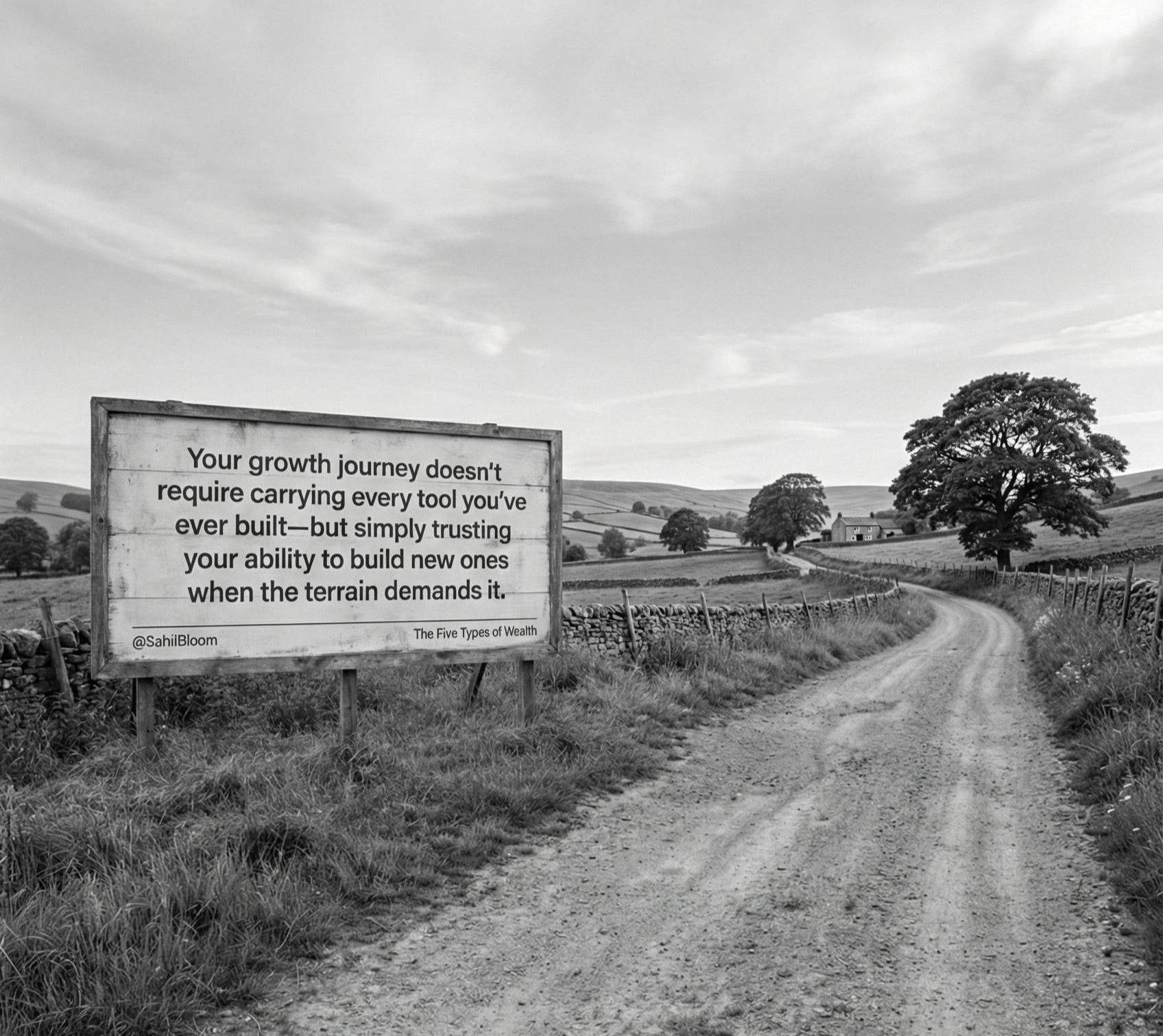
Your growth journey doesn't require carrying every tool you've ever built—but simply trusting your ability to build new ones when the terrain demands it.
So, as you start the year, ask yourself:
What boat are you still dragging long after the river is gone?