The Anti-To-Do List: A Major Life Hack

Today at a Glance
What’s a Rich Text element?
The rich text element allows you to create and format headings, paragraphs, blockquotes, images, and video all in one place instead of having to add and format them individually. Just double-click and easily create content.
Static and dynamic content editing
A rich text element can be used with static or dynamic content. For static content, just drop it into any page and begin editing. For dynamic content, add a rich text field to any collection and then connect a rich text element to that field in the settings panel. !
- ml;xsml;xa
- koxsaml;xsml;xsa
- mklxsaml;xsa
How to customize formatting for each rich text
Headings, paragraphs, blockquotes, figures, images, and figure captions can all be styled after a class is added to the rich text element using the "When inside of" nested selector system.
In the 19th century, a German mathematician named Carl Jacobi developed an interesting insight:
Many hard math problems become easier to solve when you flip them around and work backwards.
He famously preached to his students, "Man muss immer umkehren."
Translation: Invert, always invert.
As it turns out, this idea echoes across history, showing up in a variety of places before and after Jacobi:
- In medicine, the first rule drilled into every young doctor is an inversion: First, do no harm.
- In art, Michelangelo was once asked how he carved the statue of David. He's rumored to have replied that he simply removed everything that wasn't David.
- In investing, Warren Buffett said that he built his incredible track record on two simple rules: (1) Don't lose money, and (2) Don't forget Rule 1.
Charlie Munger, Warren Buffett's late business partner, distilled it even further:
"All I want to know is where I'm going to die, so I'll never go there."
Different fields. Different centuries. Same insight.
There's a name for this principle:
Via Negativa. The negative path. The path of removal.
It finds its origins in ancient theological and philosophical practices, as a way of describing God by describing what God is not.
But the application is universal:
To get closer to your truth, remove what doesn't belong. To achieve your goals and create your vision for the future, avoid what holds you back.
Today, I'd like to tell you about a practical tool for doing just that...
I call it my Anti-To-Do List.
We all know the To-Do List. That staple of modern productivity. The daily guide for where to direct your attention.
But it only governs one side of the equation. It tells you what to focus on, but nothing about what to avoid.
It's like staring at your feet while you go for a walk. You'll certainly walk somewhere, but when you eventually look up, you may realize somewhere was never really the goal.
The Anti-To-Do List is your Via Negativa tool for life:
It's a simple list of behaviors, habits, mindsets, self-limiting beliefs, or patterns that you want to avoid. The things you don't want to do. They are anti-to-dos.
Not because they're catastrophic, per se, but because they slowly hold you back from operating at full power. They silently pull you away from the life you want and deserve.
A few specifics of how to think about this list:
- Create a physical Anti-To-Do List that sits in front of you in the same way your To-Do List does. A huge part of the effectiveness of this tool is that it serves as a constant reminder when you see it.
- Keep just ~3-5 items on the list at any time. More than that and it becomes challenging to manage.
- Use "Do not [XXX]" as the syntax for each item on the list.
- The list is dynamic. Similar to your To-Do List, it should evolve over periods of time. But some items will be more persistent, as they require longer periods of focus to cement the avoidance in your wiring.
- The goal is to "graduate" items after extended periods of 100% compliance. If there was an issue plaguing you that you wanted to fix (like scrolling TikTok instead of being present with your friends), you'd have that at the top of your Anti-To-Do List until it was clear that your behavior had changed and cemented. Then you could move it down the list or remove it altogether. Replace "graduated" items with new friction points to work on.
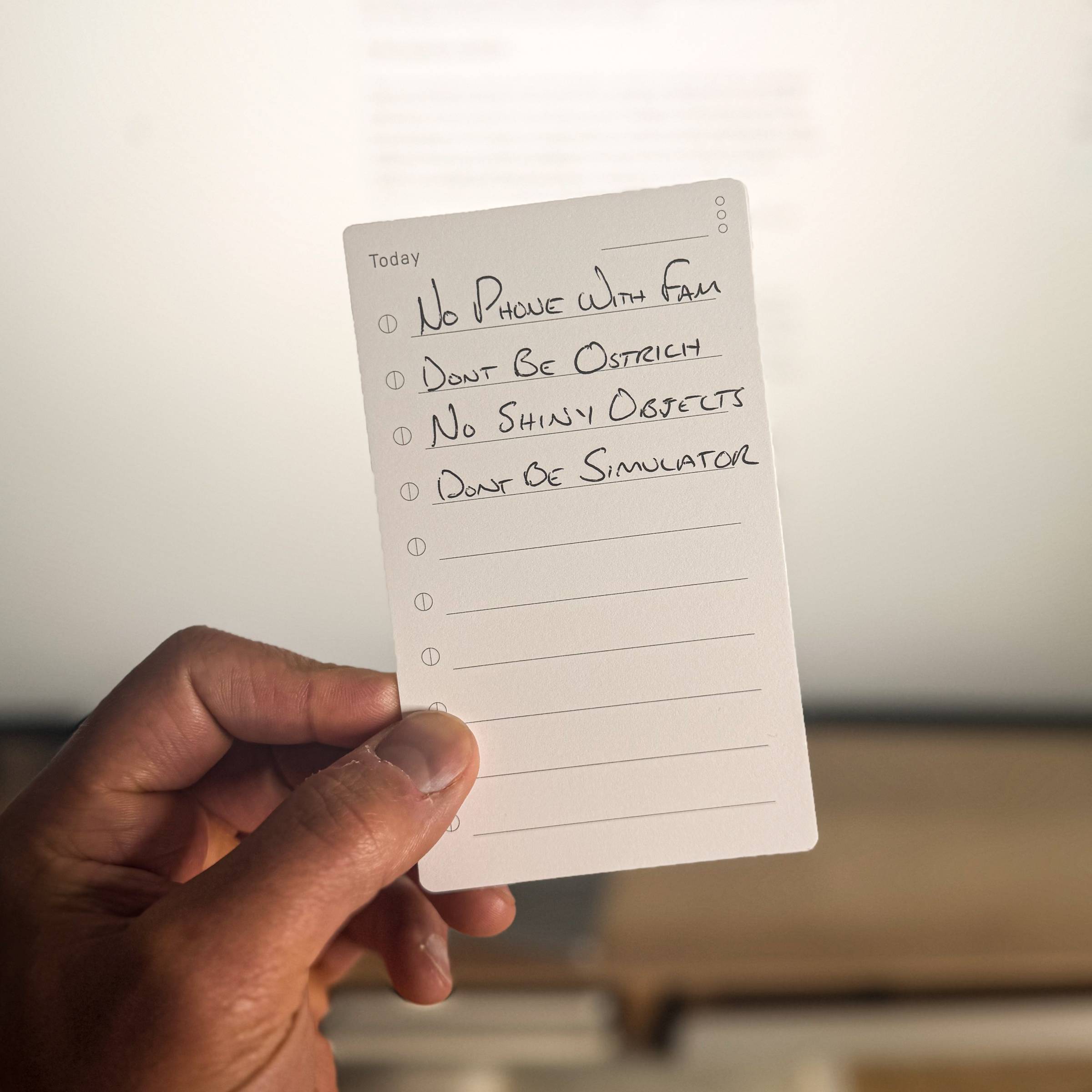
To bring this to life and help you create your own, here are some of the items that are on my current Anti-To-Do List (or have been in the past):
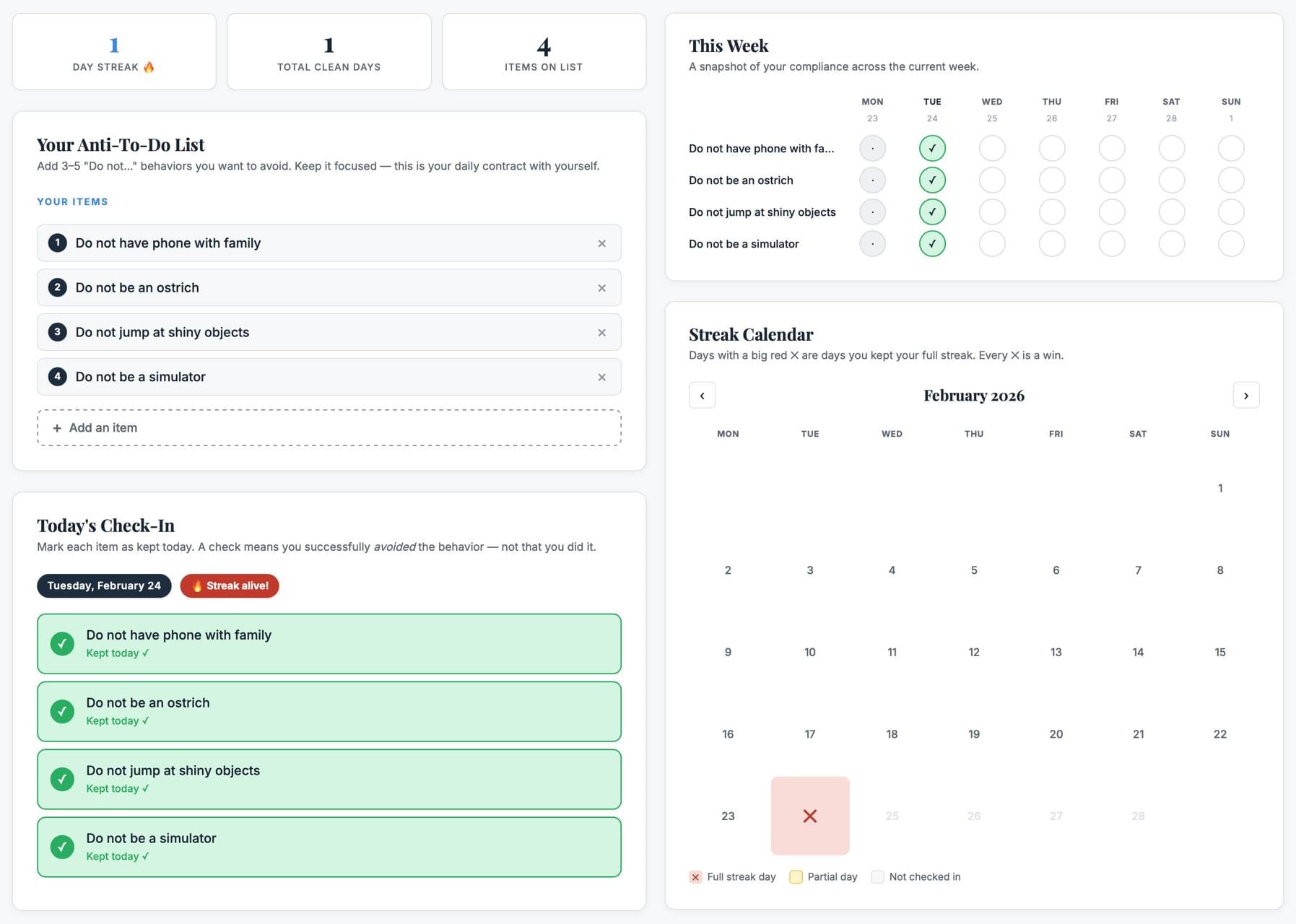
P.S. I created a simple web-based Anti-To-Do List Tracker that you can use to get started. You can find the tool here. Please feel free to share it!
My Current Anti-To-Do List
1. Do not use your phone around your family.
A few weeks ago, I wrote about my realization that everything I want to improve in life is downstream from spending less time on my phone. I also shared my plan to cut my phone addiction. That plan is working wonders in my life (more to come on that), but a big part of sticking to it long-term is having that "No phone with fam" note in front of me daily.
2. Do not be an ostrich.
There's something called the Ostrich Effect, which is named after the animal's tendency to bury its head in the sand to avoid danger. Humans are much the same when we encounter new information or evidence that challenges our pre-existing beliefs. In a rapidly changing and uncertain world like the present, your beliefs are constantly being challenged. I refuse to be an ostrich. I want to update my thinking when high quality new evidence comes to light.
P.S. This is part of Bayesian Thinking, a structured approach to updating beliefs. I'll write a piece on it soon. Reply YES to this email if you're interested!
3. Do not jump at shiny objects.
In the past, I've been a frequent victim of shiny object syndrome. I get excited about new things and spread my attention thin. Right now, I'm at a moment in my life where I have incredible clarity around my focus areas. I'm seeing it start to compound ferociously. The best way for me to screw that up would be to jump at the hundreds of shiny objects that get thrown into my orbit on a weekly basis.
4. Do not confuse simulating with doing.
A recent observation: There are a lot of ways in which we simulate something rather than doing it. You can simulate productivity by creating a million dashboards and fancy automations, but it's very different than actually being productive. You can simulate presence by being in a room, but it's very different from truly being present and opening your mind to the people you're with. You can simulate progress by gathering information, reading, seeking advice, and watching videos, but it's very different from actually doing something. I want to be a doer, not a simulator.
My Former Anti-To-Do List Items
Do not engage in energy draining communication.
The "pick your brain" and "get to know you" zooms and phone calls are where my energy goes to die. If there's not a clear purpose and action associated with a call or videoconference, I don't do it. I've never built a meaningful relationship over calls or zoom meetings, so I default to in person interaction.
Do not complain about anything.
If the thing is within your control, then go do something about it. If the thing is out of your control, then it's just a waste of energy to complain about it.
Do not assume improvement.
You can't improve what you don't track. I've fallen into this trap on several occasions. Going to the gym, but never tracking anything I was doing. Thinking about saving money, but never tracking a budget or spending. The moment you start tracking things is the moment you start improving.
P.S. On gym tracking, I use a pen and paper (old school!). On the money tracking, I use Origin. It's the best tool I've used (and $1 for the first year). I invested because I loved it.
Do not say yes to things assuming more time for them in future.
The "Yes, Damn!" Effect says that we systematically overestimate the amount of free time we will have in the future. We say yes to future things under the assumption that we will have more time for them, but when that future date arrives, we regret it. You won't have more time in the future. If you wouldn't want to do the thing tomorrow, don't say yes to doing it a month from now.
Do not hit the snooze button.
It's not about sleep, it's about stacking evidence that you are in control.
Do not graze on low-value tasks.
Parkinson's Law says that work expands to fill the time allotted for its completion. When you don't set fixed windows for managing low-value tasks (like email), you end up "grazing" on them (spending all day doing them slowly and inefficiently). Create short, discrete windows for processing low importance tasks. Leverage AI to automate these tasks as much as possible so you can ascend to higher modes of thinking and work.
Your Anti-To-Do List
Ok, now it's your turn to put this tool into action.
Here's how to create yours in the next 10 minutes:
- Audit your key domains: Think about your work, health, relationships, and personal development. Where are the challenges? What friction points have you observed? What's holding you back from operating at full power?
- Write down 3-5 items: Don't overthink it. You already know what belongs on this list. The things that make you wince when you're honest with yourself about their impact on your life (like my phone usage did). If it makes you feel nervous or uncomfortable to fight back against, it probably belongs on the list.
- Place the list somewhere you'll see it: It should be visible during your days. On your desk. In the kitchen. On your phone background. Whatever. Just make sure it serves as a trigger to course correct if you're starting to run afoul of any of the items.
Then, each day, check the items off the list. Not because you did them, but because you didn't.
Over the next few months, cement the behavior around the starting list. Then, graduate items accordingly and add new ones. The list will evolve as you do.
The Anti-To-Do List is a major life hack. Via Negativa in action. The path of removal.
The daily practice of becoming the person you want to be, by avoiding the actions of the person you don't.
P.S. I created a simple web-based Anti-To-Do List Tracker that you can use to get started. You can find the tool here. Please feel free to share it!