


Dear Parker: A Letter to a 17-Year-Old Reader

Today at a Glance
What’s a Rich Text element?
The rich text element allows you to create and format headings, paragraphs, blockquotes, images, and video all in one place instead of having to add and format them individually. Just double-click and easily create content.
Static and dynamic content editing
A rich text element can be used with static or dynamic content. For static content, just drop it into any page and begin editing. For dynamic content, add a rich text field to any collection and then connect a rich text element to that field in the settings panel. !
- ml;xsml;xa
- koxsaml;xsml;xsa
- mklxsaml;xsa
How to customize formatting for each rich text
Headings, paragraphs, blockquotes, figures, images, and figure captions can all be styled after a class is added to the rich text element using the "When inside of" nested selector system.
Last week, I got an email from a reader that stopped me in my tracks:
Dear Mr. Bloom,
My name is Parker and I am 17. I am reaching out because I would like some advice.
I have had a goal and dream since I can remember, being rich and owning some sort of business but I do not know where to start. I don't want to be rich for the wrong reasons. I want to use my money as freedom for myself and to use it as a way to help others. My goal is to make 1 million by the time I am 20.
I was wondering if I could have some mentorship on how I could achieve this goal. I come from a poor family so money is hard for us but I will do whatever it takes to achieve this no matter what.
I hope this finds you well, thank you for your time.
I wrote back quickly, but I haven't been able to stop thinking about it. Parker deserved more than a quick email.
Because I know there are a lot of Parkers out there. Perhaps the specific situation varies, but the general one is the same:
Big dreams, hunger, and motivation. A desire for financial security and success. And no idea where to start.
In fact, I'd bet we all see a little bit of ourselves in Parker. I know I do.
So, I sat down for a day to properly answer his question:
What would I tell him? What advice would I give? What tactical playbook would I provide?
This is my open letter to Parker—and to anyone out there with big dreams and no idea where to start...
Dear Parker,
I'll cut straight to it. Three things I want to say upfront:
- I'm going to avoid any fluff. This is the action plan. This is exactly what I would do if I were in your shoes today. The playbook I'd follow, knowing what I know now. No bullshit. No noise.
- I'm not going to tell you this is going to be easy. Anyone that sells you the "easy way" is scamming you. Nothing worth having in life is easy. But that's the fun of it. The hard-earned win is the best feeling in the world.
- If you do follow this, your life is going to look completely different in one year.
Ok, with those out of the way...
You said your goal is to make $1 million by the time you're 20 (in ~2-3 years).
That's the wrong goal.
That's just an arbitrary number by an even more arbitrary deadline. The goal isn't a number or a date.
The goal is to build a machine that generates wealth forever.
The machine is what allows you to break free. It's what allows you to achieve your dreams. It’s what allows you to take care of your people and give back to the world.
This is how you go build your wealth machine:
Note: Follow this in sequential order. The order matters.
Gear 1: Mindset
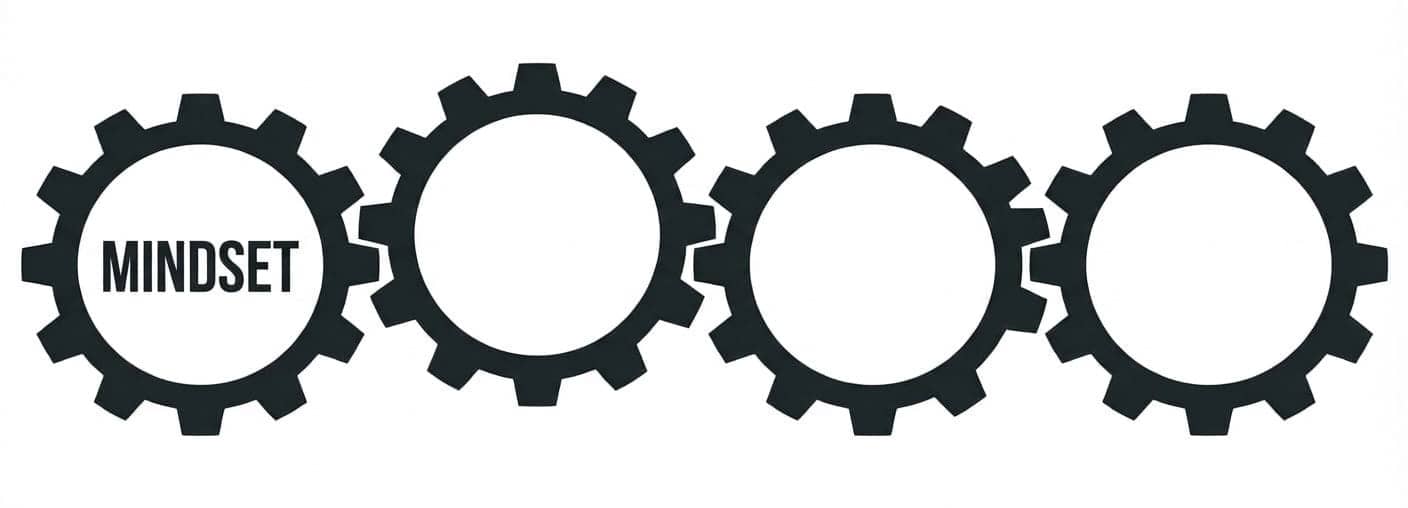
Don’t roll your eyes at this. It’s important. And it all begins here.
Ultimately, your success requires one thing: Agency. The belief in your ability to take an action to create a desired outcome.
When you have agency, you’re never out of the fight. And without agency, you’re never really in it. You get stuck. Blame outside forces for your situation. Allow life to happen to you.
But I don’t believe in whimsical mindset changes. I’m not going to tell you to look in the mirror and tell yourself that you’re great. If you want to do that, fine, but let’s make this more tangible.
Here’s your action:
For the next 30 days, every single day, wake up at 5am and work out for at least 30 minutes.
It doesn’t matter what the workout looks like. I don’t care if you go to a gym, go outside for a run, or do pushups and squats on your bedroom floor.
Because this isn’t about the workout. It’s about creating Proof of Agency.
By the end of 30 days, you’ll completely rewire your brain. Scientists call it neuroplasticity. Your brain physically changes in structure and function through action and experience.
The action of waking up early and working out every single day for a month will create evidence that you have the power to take an action and achieve a desired outcome. You’ll see yourself differently. You’ll reorganize your life around this new priority. You’ll eat healthier, go to sleep earlier, and narrow your focus.
It creates Proof of Agency. That has ripple effects into every area of life.
And it drives the next stage of your machine…
Gear 2: Skills
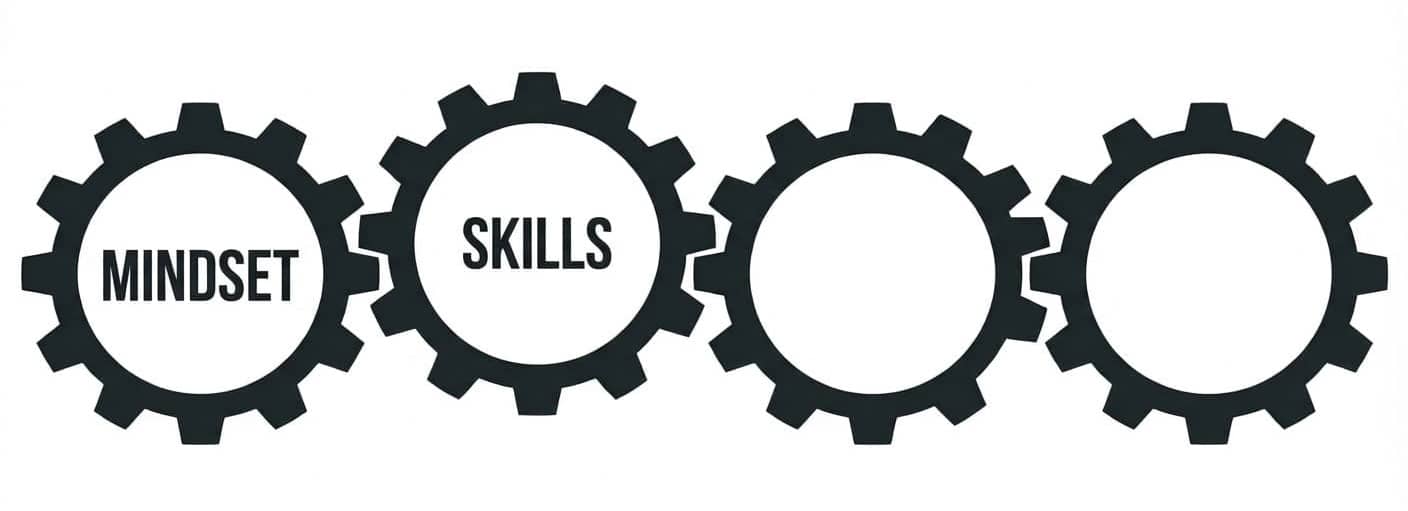
Here's a harsh truth: No one hands out money. No one is going to pay you just because they like you or think you're cool. That's not the way the world works.
Money earned is a direct byproduct of value created.
Whether you’re working in a traditional role as an employee or trying to make it as an entrepreneur, the formula is the same:
You create value by using your skills to solve other people’s problems.
So, tactically, how do you go about this:
First, map your current skills.
On a blank sheet of paper, write down your existing professional skillset. What can you currently offer in the market at a moderate or high competency level?
If you don’t know where to start, play my game of 3s:
- What are 3 things friends ask you to help them with?
- What are 3 things you seem to do better than your friends?
- What are 3 things you’d do for free?
This will help you figure out your starting inventory to build from.
Next, map the problems you can solve with those current skills.
Spend a week logging the friction points (i.e. problems) all around you.
Open your eyes and ears. Observe. Ask people what’s holding them back in business or life. Talk to strangers at your local businesses. Send cold DMs and emails.
Which of these problems might you be able to solve with your current skills?
Maybe you’re pretty good with video editing and you notice a few local businesses have zero social media presence. That’s a problem that you can solve with your skill.
Maybe you’re pretty good with AI tools and you talk to a CEO who has no idea how much time they’re wasting by not implementing a few simple automations. That’s a problem that you can solve with your skill.
Then, map out the bigger problems you could solve with a larger skill stack.
This is where it starts to get interesting.
As you start to create value, reinvest your free time, energy, and money to stack skills that compound the value you can create.
Providing direct AI consulting to a single CEO is nice, but if you stack design and sales skills, you may be able to provide that AI consulting service to larger enterprises. Stack coding and storytelling skills and you may be able to scale it across multiple enterprises.
The $1,000 per month individual client suddenly becomes several $100,000 per year enterprise level contracts.
This part is iterative. Continue to identify new and bigger problems, more scalable ways to solve them, and the skills you need to build to do that. Keep stacking skills.
Learn is much more important than earn in the early days.
Build your potential energy, don’t worry about the kinetic just yet.
This is not going to be fun (at least not in a traditional sense). You’re going to be giving up most of your free/leisure time in order to build marketable skills. But the rewards of that sacrifice will be significant.
P.S. If you're reading this and thinking it only applies to entrepreneurs, it doesn't. The employee who stacks skills and solves bigger problems is the one who gets promoted faster, gets poached by headhunters, and has leverage in every negotiation. The formula is the same whether you're building a company or building a career inside one.
Gear 3: Network
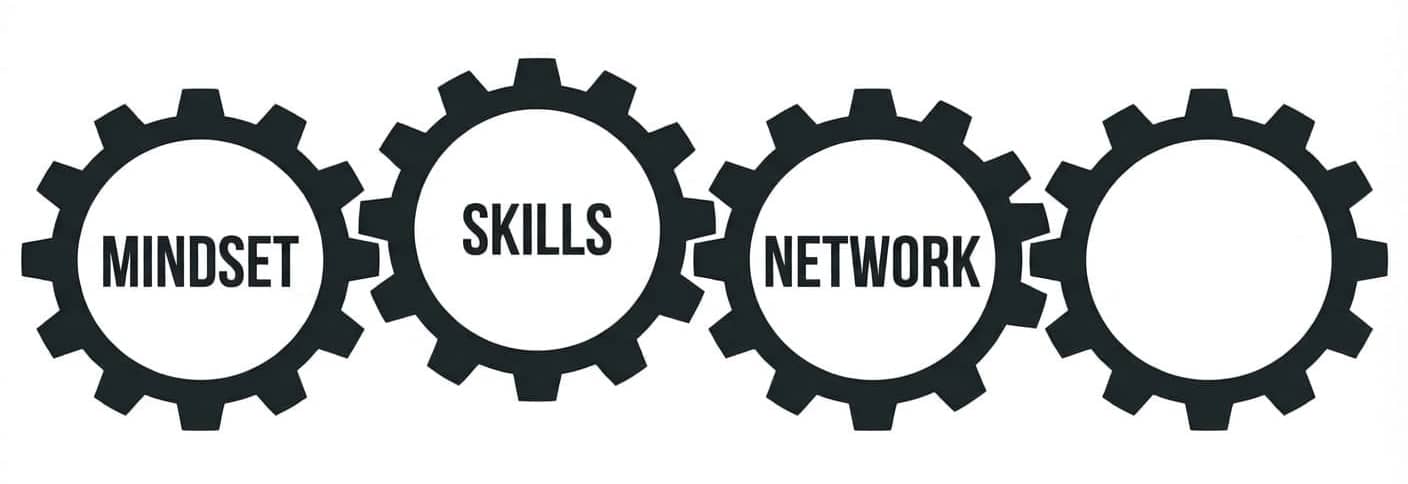
This is why skills come before network: Your skills become networking magnets.
Most people get this backwards.
They read about the importance of networking. Maybe someone told them that your network is the key to making money.
The truth is that you can’t build a powerful network if you have nothing of value to provide. You don't build a network by gathering business cards or handing out a fancy resume. You build a network by being valuable.
So, start building in public.
Open an X account. Create a LinkedIn. Start a YouTube or Instagram account. The people you want to meet are watching for people who are doing. Share your skill-building and value-creating journey.
Then start constructing a powerful network to accelerate your path.
I think there are three important areas in a network:
- Peers: This is your core circle. Proximity to a circle of doers is the most meaningful life accelerant you can find. And if you want to find that circle, you need to be one yourself.
- Mentors: These are people 5-10 years ahead of where you are today. To get access, solve a small problem for them without asking permission. Identify a problem they’re facing, use your skills to solve it, provide that solution. Once you’ve unlocked access, shadow them, work for them (for free if needed), learn from them.
- Students: These are people a few years behind you. Pay it forward by carving out a little bit of space to share what you learn. This is important. Everything you give will be returned to you tenfold. Plus, the teaching will help cement your learnings.
The circle you build in the next 5 years will shape the next 50.
With the first three gears cranking, we come to the final piece of the machine…
Gear 4: Money
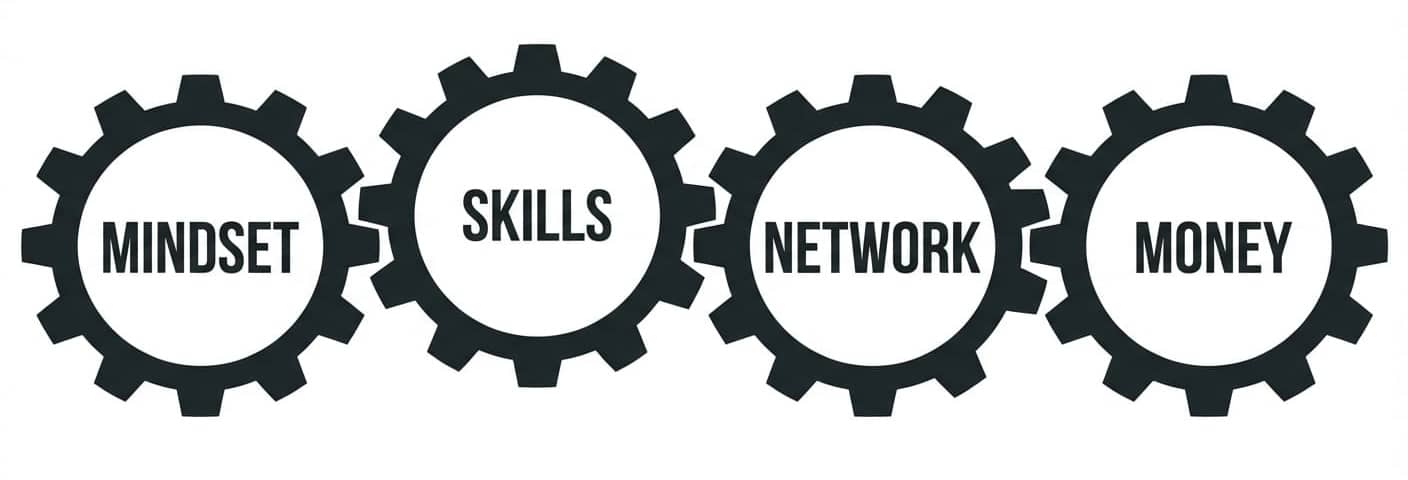
There are three basic levers when it comes to money:
- Income: Cash inflows
- Expenses: Cash outflows
- Investments: Long-term compounding assets
If your goal is to achieve financial security and independence, you need to understand how to manipulate these levers to your advantage.
First, grow your income by leveraging your skills and network.
MAKE IT.
You’ve already done the hard work here. Leverage the skills and network you’ve built to make money. You’ll scale your income as you stack skills and solve bigger problems.
Next, manage your expenses by living well below your means.
SAVE IT.
This is the hardest part for any young person as they start to earn more income.
Most people will match every increase in income with a corresponding increase in spending.
- Get a pay raise? Move into a nicer place.
- Land a new client? This calls for a new car.
- Launch a new business? Time for a fancy watch.
That’s the behavior that keeps you stuck forever. I know people who live paycheck-to-paycheck while making seven figures, simply because they’ve allowed their lifestyle to expand faster than their earnings.
If you want to break free, you need to live differently. You should aim to bank at least 50% of every income increase.
Even better, bank the entire thing for a few years. Keep your lifestyle stable while you build a foundation.
Create some rules to help you stick to it. I use a 24-hour-rule with larger purchases. If I want something, I wait 24 hours before purchasing it. I usually cool off during that period and realize I don’t really need the thing after all.
This isn’t going to be fun, but it’s necessary. Let your friends spend. You’re trying to build something real.
Finally, invest the gap between your income and expenses into long-term, low-cost compounders.
GROW IT.
You don't need to be a stock picker or a crypto genius. In fact, you shouldn’t be either of those things.
Open two accounts:
- A savings account that pays a decent interest rate.
- A brokerage account to invest in low-cost index funds.
Set up an automatic monthly deposit into each one. If your total pie is the gap between your income and expenses, you can start by splitting the middle and sending 50% of that into each of the two accounts.
The savings account is your cash safety net. Once that account hits a balance equivalent to ~12 months of your total expenses, you can shift to sending 100% of your monthly gap between income and expenses into the brokerage account.
Remember: Compounding is just returns to the power of time. Time is the exponent. It‘s your single greatest wealth building asset. Start now and let the machine get to work.
(P.S. My wife and I use Origin to track and manage all of this stuff. We liked it so much that we invested. I think it’s the best tool out there.)
Putting It All Together
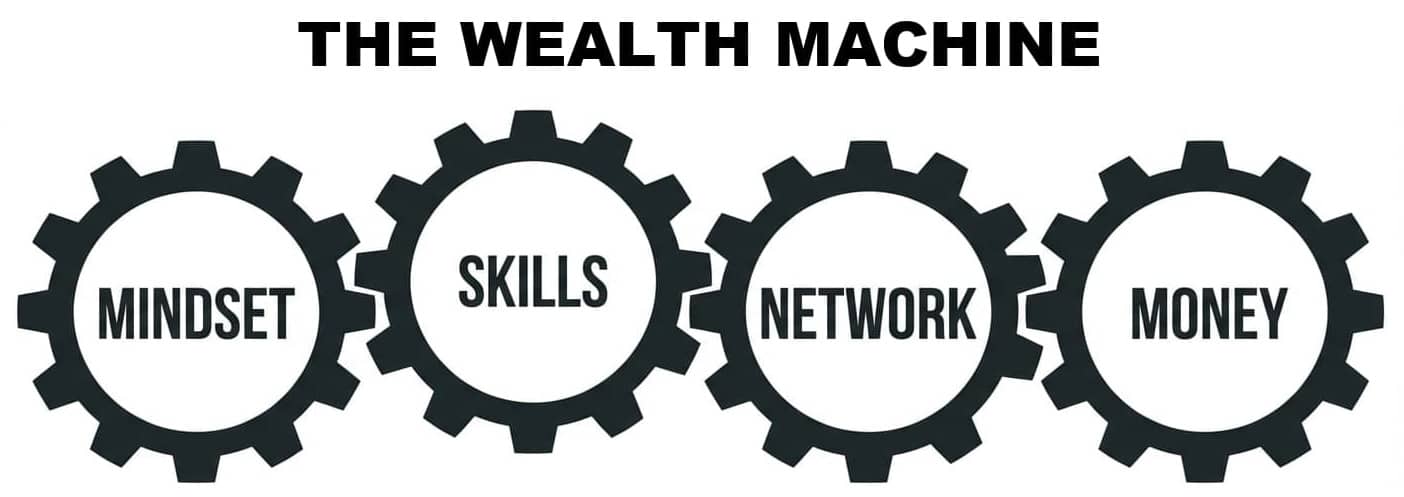
Those four gears come together to form a powerful wealth machine.
And perhaps most importantly, building that machine prepares you for having the wealth it creates.
If you got dropped on the top of Mount Everest, you'd immediately pass out and die because you aren't acclimatized to the altitude. The climb prepares you for the summit.
There’s a reason so many lottery winners end up losing it all. They got to the summit without enduring the climb.
So, Parker, I hope this has been more helpful than my short email.
Your future is extremely bright. Not because of anything magical coming your way. And not because you’ve now got the information you need.
Your future is bright because you understand the truth:
Nobody is coming to save you. You are in control. It's all on you. But you are entirely capable of figuring it out. Of squeezing everything you want out of this life. You can wake up tomorrow and completely reinvent yourself. You are at the wheel. Never let go.
Please stay in touch.
Sahil


