The Protégé Effect: A Powerful Model for the AI Era

Today at a Glance
What’s a Rich Text element?
The rich text element allows you to create and format headings, paragraphs, blockquotes, images, and video all in one place instead of having to add and format them individually. Just double-click and easily create content.
Static and dynamic content editing
A rich text element can be used with static or dynamic content. For static content, just drop it into any page and begin editing. For dynamic content, add a rich text field to any collection and then connect a rich text element to that field in the settings panel. !
- ml;xsml;xa
- koxsaml;xsml;xsa
- mklxsaml;xsa
How to customize formatting for each rich text
Headings, paragraphs, blockquotes, figures, images, and figure captions can all be styled after a class is added to the rich text element using the "When inside of" nested selector system.
AI is quite clearly the biggest buzzword of the year.
It's become the hottest investment sector, a core political issue, a corporate strategy talking point, and the subject matter of group chats and family dinner conversations around the world.
But one thing I don't see anyone talking about is just how much AI is shifting how rewards are earned.
And I think that shift has profound implications for how we (and our children) will think about thriving in the coming era.
For the longest time, it seemed like the world rewarded those who followed a clear, logical path. People who:
- Anticipated valuable skills of the future
- Acquired those valuable skills (through school or apprenticeship)
- Leveraged those valuable skills in the market to earn money
Maybe you were in school in the early 2000s and anticipated that coding skills would be valuable in the coming decades. You went to school, studied, acquired those skills, and have likely spent many years leveraging those skills to earn money.
The problem: I don’t think that works anymore.
Because things are changing so rapidly that the frontier of accurate prediction has been pulled closer and closer to the present. In other words, if you used to be able to accurately predict a decade or two out into the future, now it feels like you can (maybe) accurately predict six months into the future.
There are certainly "meta-skills" that will always be valuable (reply YES if you want to read a post in the future on what these skills are), but the specific skills to build underneath those are more challenging to predict.
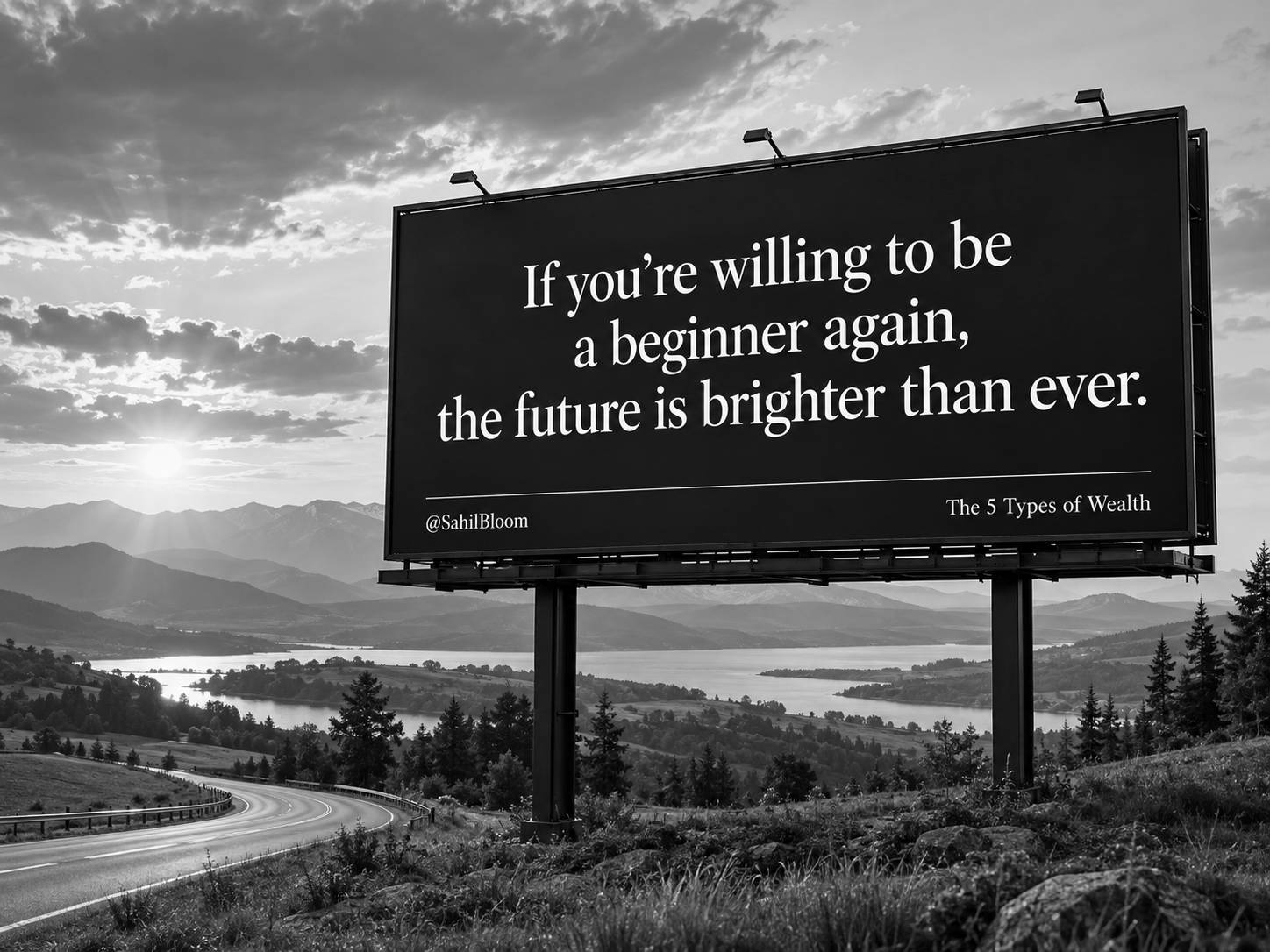
In this new world, the rewards will be earned by those who are willing to be beginners over and over again. The value seems likely to accrue to those who can combine curiosity and a beginner's mindset with bias for action.
This means that learning has become a core meta-skill. Perhaps even THE core meta-skill. The faster and more effectively you can learn and unlearn, the more quickly you'll adapt to the fast-changing times that are coming.
In a simple sense, your learning method has become the most valuable, leveraged thing in your arsenal.
So, how do you build a powerful, agile, effective learning method?
Well, the answer isn't new.
In one of his letters, Seneca wrote, "Welcome those whom you yourself can improve. The process is mutual; for men learn while they teach."
The sentiment later hardened into a Latin proverb:
Docendo discimus. Translation: By teaching, we learn.
This idea goes well-beyond conjecture.
In 2009, Stanford researchers conducted a study with a group of eighth graders at a nearby middle school. The students were told they would go through a few biology lessons. Half of the students were told that they'd simply be studying the material for themselves, while the other half was told that they'd be learning it so that they could teach it to a digital character named Betty.
They all worked through the same lessons, but the group that was learning in order to teach worked much harder. They read more, revised more, and generally plugged into the work more deeply.
And when the two groups were tested on the material, who do you think performed better?
You guessed it, the teaching group outperformed the non-teaching group, with a more pronounced gap on the hardest questions on the test.
The researchers coined the term Protégé Effect for the psychological phenomenon where teaching, preparing to teach, or pretending to teach information to someone else helps you learn and retain that information better yourself.
A 2014 experiment by a separate group of researchers found that the mere expectation of needing to teach the material later led to better and faster recall of information.
The expectation is important. Because it wasn't the act of teaching that cemented learning.
In fact, in a meta-analysis of 39 studies, students who were surprised with a teaching task saw no learning benefit. It was the expectation of needing to teach that pushed students to more effectively weigh, organize, and synthesize material.
Ok, now for the so what? of all of this...
How do you incorporate this into the way you learn and build new skills and knowledge?
The key here isn't to teach more but to decide you'll teach it before you start learning.
Before you start learning, decide who you're going to teach it to. Ideally, this would be someone uninitiated in the topic, which forces you to distill and simplify the concept, requiring a real, deep understanding of the source material.
After all, if you can't explain it simply, you don't really understand it.
It could be a friend, partner, child, parent, sibling, whatever.
Or, it could be your favorite AI tool. You could try feeding it this prompt (which I've found quite effective in the past):
I am trying to learn about [X]. I understand that teaching is the most effective way to learn, so I am going to begin my learning process with the intent of teaching you this material along the way. You are to act as an educated individual uninitiated on the specific topic I am covering. Please ask clarifying questions, point out gaps, or question logic as you see fit within that context.
You'll commit to the teaching before you start the learning, which will force you to engage more deeply as you do.
Then, make it iterative. Do the teaching along the way. See what questions get asked, what holes get poked, what statements raise eyebrows. Go back into study mode to fill those gaps before returning.
This is an adapted version of what's often called the Feynman Technique, named for the Nobel Prize-winning physicist who famously used the expectation of teaching with simplified language as a forcing function for deep learning.
Your learning loop will look something like this:
- Name the person you're going to teach it to.
- Study the material.
- Teach it to the person. Identify the gaps from the experience.
- Study to fill the gaps.
- Teach it again.
The old world placed an emphasis on anticipation. Accurate prediction of the future.
But we no longer live in that old world.
The new world will place an emphasis on adaptation. Rapid iteration. Learning and unlearning.
Build your learning muscle. Teach to learn.
It sounds scary. It shouldn't.
If you're willing to be a beginner again, the future is brighter than ever.