


The Energy Audit: A Practical Approach to Finding Flow

Today at a Glance
What’s a Rich Text element?
The rich text element allows you to create and format headings, paragraphs, blockquotes, images, and video all in one place instead of having to add and format them individually. Just double-click and easily create content.
Static and dynamic content editing
A rich text element can be used with static or dynamic content. For static content, just drop it into any page and begin editing. For dynamic content, add a rich text field to any collection and then connect a rich text element to that field in the settings panel. !
- ml;xsml;xa
- koxsaml;xsml;xsa
- mklxsaml;xsa
How to customize formatting for each rich text
Headings, paragraphs, blockquotes, figures, images, and figure captions can all be styled after a class is added to the rich text element using the "When inside of" nested selector system.
A few weeks ago, I wrote a piece about my 90-10 Rule for Routines.
I argued that routines have a sort of sweet spot. Too loose and you never get the benefit from the discipline and structure. Too rigid and completion of the routine becomes a source of stress in and of itself.
The 90-10 Rule is a rough framework I follow to try to stick to my structured routines 90% of the time, while leaving 10% guilt-free breathing room for life to happen.
But there was something I didn’t address:
The 90-10 Rule assumes the routine itself is right for you.
That the right things are happening at the right times.
Sometimes, they aren’t. For years, mine weren’t, and the fix was actually quite simple.
Let me explain…
I’ve been an early morning workout guy most of my adult life. I think the pattern got wired into me from the early morning training during my college baseball years at Stanford. I liked the feeling of pushing myself while the campus was still asleep.
So, like most patterns, it stuck. I carried it with me as I entered into the real world. I’d hit the gym at 4:45am without fail, get to the office by 6:30am and grind out the days.
I held onto it when I started building my own businesses. No longer having a fixed daily structure handed down by a boss, I clung to the morning workout as an anchor.
It became part of my identity.
But as I started writing my book in 2022, a problem began to emerge.
I’d hit the morning workout straight out of bed, come home, eat breakfast, and sit down at my desk by 8am, all fired up to write. And I’d stare at the screen, distract myself with whatever nonsense I could find (there’s plenty of it out there!), and make precisely zero forward movement.
I was struggling to find the focused, creative headspace to make progress on a daily basis.
So to try to figure out a solution, I did an exercise that I called an Energy Audit.
It was painfully basic. Throughout each day over the course of a week, I just jotted down notes on what my energy felt like at different times of the day.
- Feeling creative? Make a note
- Feeling physically wired? Make a note.
- Feeling focused? Make a note.
- Feeling drained? Make a note.
- Feeling anxious? Make a note.
I didn’t over-analyze it in the moment. Just stream of consciousness.
After the week, I looked at it to try to identify trends.
Two things jumped out:
My most focused, creative window of energy consistently seemed to appear straight out of bed after a bit of caffeine.
The exact window when I was jumping in the car and driving to the gym to go bang some weights around for an hour.
And my physical energy seemed to peak a bit later in the morning and then stay fairly steady.
The book was my “most important thing” from a professional standpoint, but it was being jammed into a sub-optimal time slot by a legacy routine structure that demanded a morning workout.
So, I decided to run a little test.
For one week, I’d write first thing in the morning. And go to the gym after that.
That one week test is now 4 years running.
My entire first book was written between 4:30 and 7:30am over the course of two years. My second book will be the same.
As it turns out, this wasn’t just a personal quirk. It has real science behind it.
In a 2019 paper in Nature Communications, researchers published the results of their study of nearly 700,000 genetic samples, which found that preference for morning or night is partly shaped by our genes.
In other words, your natural predisposition toward certain times of day is a real thing.
Sometimes, the best thing you can do for your routine is to identify what that natural energy looks like and find a way to place that most important thing squarely into the window when you’re best suited to work on it.
I have an extraordinary author friend who gets her best work done after 10pm, when the house is quiet and her kids are asleep. She thinks I’m crazy. I think she’s crazy. Neither of us are.
And it doesn’t just apply to creative work.
Entrepreneurs. Business leaders. Managers. Name the role. People vary in the windows when they get their deepest, most meaningful work done.
Making sure you’re doing that meaningful work during the window when you should is the goal of this exercise.
Ok, so how do you find your ideal windows for your most important work?
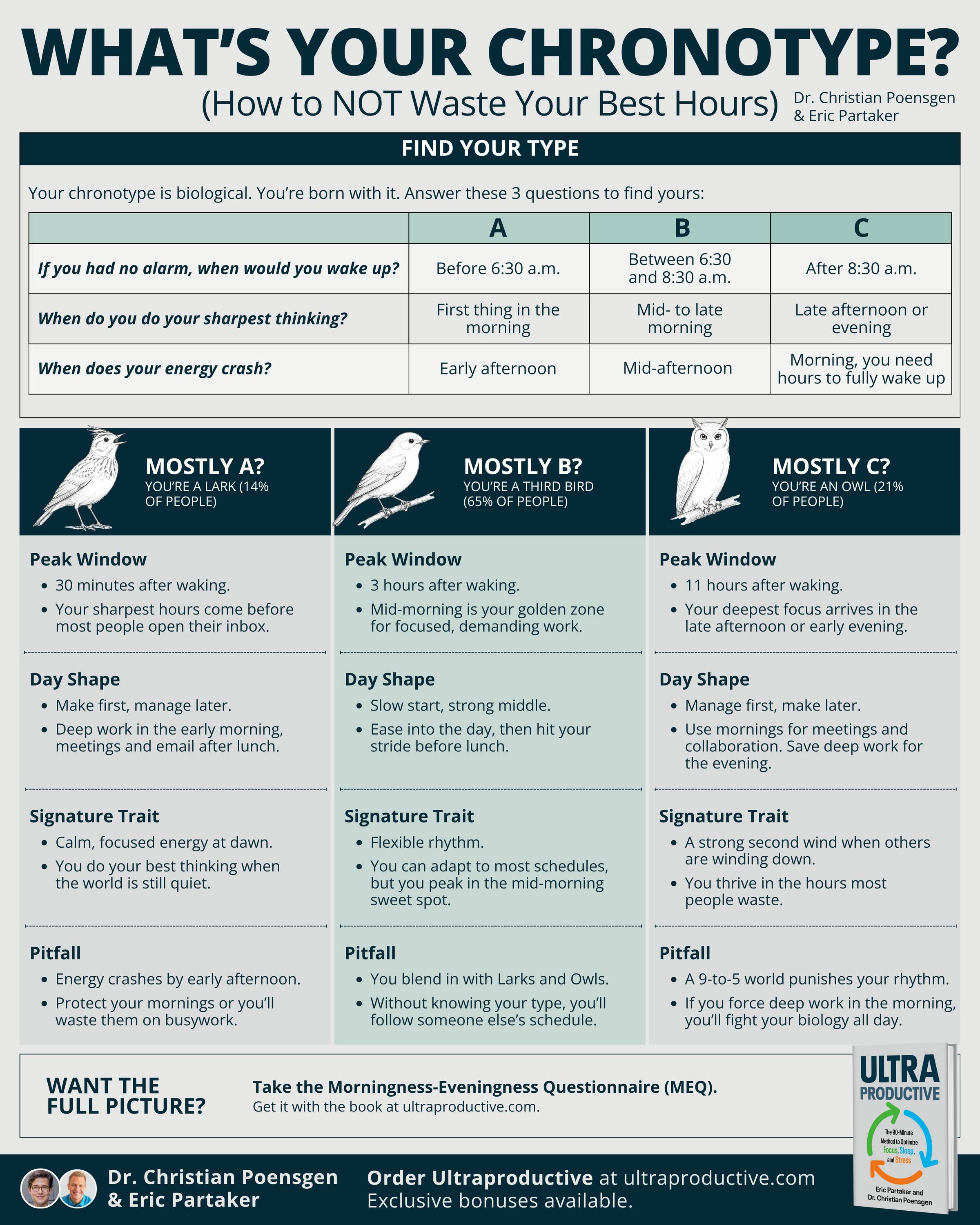
In their thought-provoking new book, Ultraproductive, sought-after CEO coach Eric Partaker and Dr. Christian Poensgen offer three questions to help identify yours:
- If you had no alarm, when would you wake up?
- A: Before 6:30am
- B: Between 6:30 and 8:30am
- C: After 8:30am
- When do you do your sharpest thinking?
- A: First thing in the morning
- B: Mid to late morning
- C: Late afternoon or evening
- When does your energy crash?
- A: Early afternoon
- B: Mid-afternoon
- C: Morning (you need hours to fully wake up)
If your responses were mostly A, you’re a Lark (morning person). Mostly C, you’re an Owl (night person). Mostly B, you’re a Third Bird (somewhere in between).
According to the research cited in the book, the peak windows for each:
- Lark: About 30 minutes after waking
- Third Bird: About 3 hours after waking
- Owl: Late afternoon or evening
This will give you a quick hypothesis, which you can test with my Energy Audit process described above.
With the information in hand, think about one way you can test a timing adjustment in your routine. Pick one important task and try moving it to your peak window for a week.
It could become a one week test that turns into a 4-year transformative one, just like it did for me.
P.S. The authors of Ultraproductive are offering a bunch of bonuses for any preorders. You claim them here.


