Click Here
Cart

Order the instant New York Times bestseller: The 5 Types of Wealth

Order My NYT Bestselling Book

Winner's Game vs. Loser's Game

Sahil Bloom

Welcome to the 242 new members of the curiosity tribe who have joined us since Wednesday. Join the 57,887 others who are receiving high-signal, curiosity-inducing content every single week.

What’s a Rich Text element?

The rich text element allows you to create and format headings, paragraphs, blockquotes, images, and video all in one place instead of having to add and format them individually. Just double-click and easily create content.

Static and dynamic content editing

A rich text element can be used with static or dynamic content. For static content,

just drop it into any page and begin editing. For dynamic content, add a rich text field to any collection and then connect a rich text element to that field in the settings panel. Voila!

  • mldsa
  • ,l;cd
  • mkclds

How to customize formatting for each rich text

Headings, paragraphs, blockquotes, figures, images, and figure captions can all be styled after a class is added to the rich text element using the "When inside of"

nested selector

system.

"No unforced errors."

At a recent speaking event, I was asked by an audience member to share one piece of advice I wish I could tell my younger self.

Specifically, they asked for the non-obvious advice I've found most difficult to internalize and live by, despite knowing its importance.

My response:

No unforced errors.

Three words. And I've spent years learning why they're so hard to live by.

In his 1970 book, Extraordinary Tennis for the Ordinary Player, scientist Simon Ramo broke down the difference between amateur and professional tennis:

  • Amateur tennis is a Loser's Game: 80% of points are lost on unforced errors. You win by avoiding errors and waiting for your opponent to make errors.
  • Professional tennis is a Winner's Game: 80% of points are won on incredible shots. You win by hitting beautiful, elegant shots.

I haven't played tennis since I was a kid, but this is a mental model that extends well beyond the confines of the court.

The model has two core implications:

  1. You have to know what game you're playing. There's negative value in attempting to hit magnificent shots if you're playing a Loser's Game. You increase your error rate and risk knocking yourself out of the game. You're better off keeping it simple and avoiding mistakes.
  2. The game you're playing might change as you ascend through its levels. Just like in tennis, what starts out as a Loser's Game can become a Winner's Game. You may be rewarded for playing conservatively early on, but aggressively later.

But here's an important truth it took me too long to learn:

Most games in life are Loser's Games.

You don't get rewarded for complex, magnificent shots. You get rewarded for consistently showing up and staying in the game. For being reliable. For figuring it out. For doing what you say you're going to do.

You get rewarded for avoiding unforced errors.

I've wrestled with this reality at every stage of my life.

When I arrived at Stanford on a baseball scholarship in 2009, I was convinced that everything had changed.

During my freshman fall, I strained, pressed, and grunted in an effort to put everything I had into each perfect pitch.

But the results were horrific. The worst I'd experienced in my baseball career to date. I got behind in counts, walked batters, and gave up a whole lot of hits. It was discouraging.

That all changed when an assistant coach pulled me aside and offered one piece of advice:

"You're playing the wrong game."

What he meant: I had achieved success in my career by consistently throwing strikes. By making the hitters beat me. Now, I was attempting to throw perfect pitches with maximum intensity. I was trying to beat the hitters.

With his advice, I was back on track. I never blew anyone away, but I had a successful college baseball career.

By simply refusing to beat myself. No unforced errors.

This experience is a common one because there are forces that conspire against you:

Every time you grow to enter a new room, you feel imposter syndrome start to build, and you convince yourself that the game has changed:

What got me here won't get me there. Now I need to do something dramatic to prove I belong.

So, you press. You strain. You force complexity into something that once felt simple.

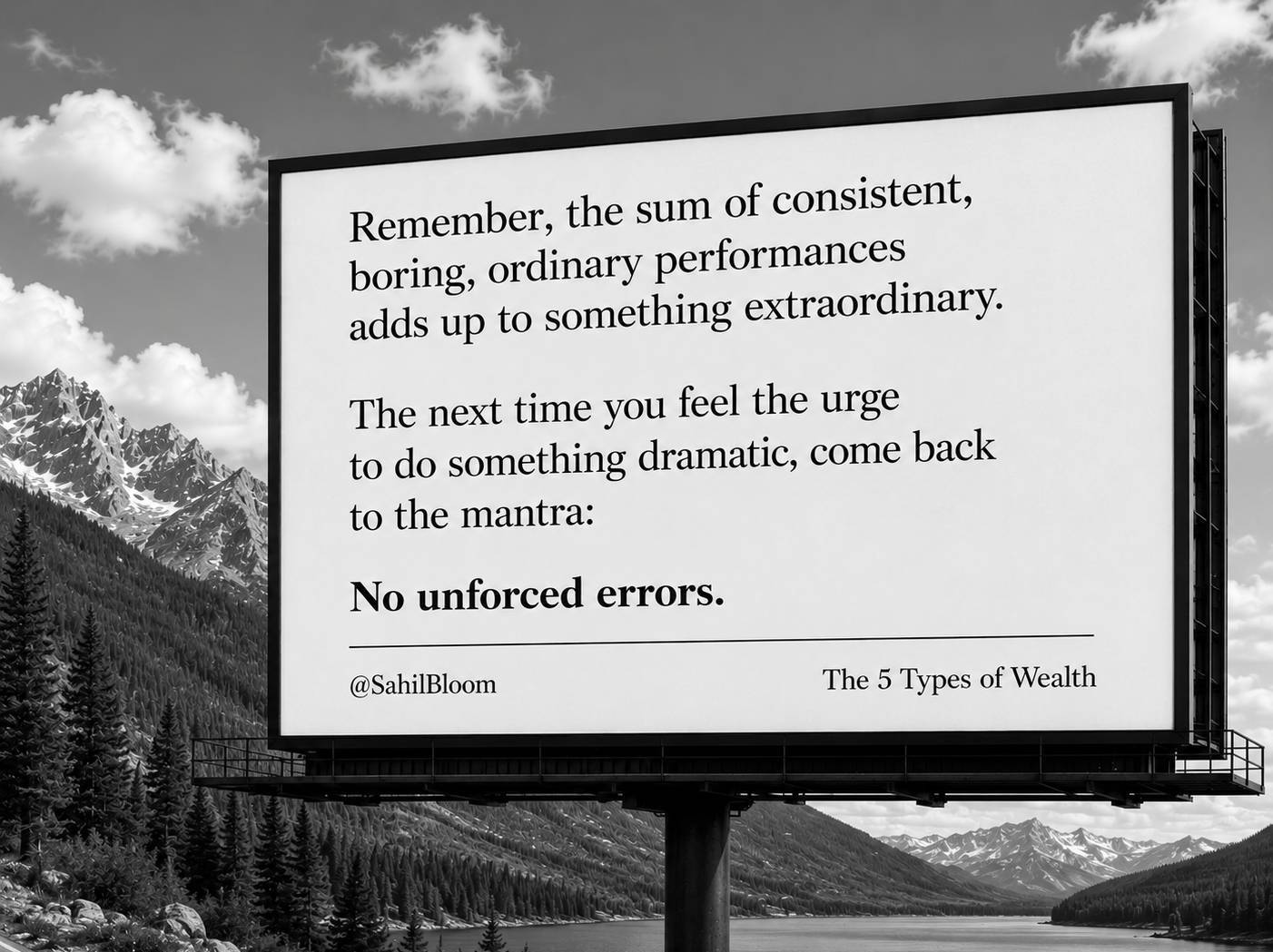
But remember, the sum of consistent, boring, ordinary performances adds up to something extraordinary.

The two questions I often ask myself:

  1. What type of game are you playing? Most games of life—professional, personal, health, and more—are Loser's Games. You get rewarded for showing up consistently, not showing up magnificently.
  2. Has the game really changed, or just your perception of it? With each new room comes the temptation to change the way you play. But it's very rare that you need to. You're in this room for a reason. You earned it. Act like it.

The next time you feel the urge to do something dramatic, to prove you belong, come back to the mantra:

No unforced errors.
Winner's Game vs. Loser's Game

Sahil Bloom

Welcome to the 242 new members of the curiosity tribe who have joined us since Wednesday. Join the 57,887 others who are receiving high-signal, curiosity-inducing content every single week.

What’s a Rich Text element?

The rich text element allows you to create and format headings, paragraphs, blockquotes, images, and video all in one place instead of having to add and format them individually. Just double-click and easily create content.

Static and dynamic content editing

A rich text element can be used with static or dynamic content. For static content,

just drop it into any page and begin editing. For dynamic content, add a rich text field to any collection and then connect a rich text element to that field in the settings panel. Voila!

  • mldsa
  • ,l;cd
  • mkclds

How to customize formatting for each rich text

Headings, paragraphs, blockquotes, figures, images, and figure captions can all be styled after a class is added to the rich text element using the "When inside of"

nested selector

system.

"No unforced errors."

At a recent speaking event, I was asked by an audience member to share one piece of advice I wish I could tell my younger self.

Specifically, they asked for the non-obvious advice I've found most difficult to internalize and live by, despite knowing its importance.

My response:

No unforced errors.

Three words. And I've spent years learning why they're so hard to live by.

In his 1970 book, Extraordinary Tennis for the Ordinary Player, scientist Simon Ramo broke down the difference between amateur and professional tennis:

  • Amateur tennis is a Loser's Game: 80% of points are lost on unforced errors. You win by avoiding errors and waiting for your opponent to make errors.
  • Professional tennis is a Winner's Game: 80% of points are won on incredible shots. You win by hitting beautiful, elegant shots.

I haven't played tennis since I was a kid, but this is a mental model that extends well beyond the confines of the court.

The model has two core implications:

  1. You have to know what game you're playing. There's negative value in attempting to hit magnificent shots if you're playing a Loser's Game. You increase your error rate and risk knocking yourself out of the game. You're better off keeping it simple and avoiding mistakes.
  2. The game you're playing might change as you ascend through its levels. Just like in tennis, what starts out as a Loser's Game can become a Winner's Game. You may be rewarded for playing conservatively early on, but aggressively later.

But here's an important truth it took me too long to learn:

Most games in life are Loser's Games.

You don't get rewarded for complex, magnificent shots. You get rewarded for consistently showing up and staying in the game. For being reliable. For figuring it out. For doing what you say you're going to do.

You get rewarded for avoiding unforced errors.

I've wrestled with this reality at every stage of my life.

When I arrived at Stanford on a baseball scholarship in 2009, I was convinced that everything had changed.

During my freshman fall, I strained, pressed, and grunted in an effort to put everything I had into each perfect pitch.

But the results were horrific. The worst I'd experienced in my baseball career to date. I got behind in counts, walked batters, and gave up a whole lot of hits. It was discouraging.

That all changed when an assistant coach pulled me aside and offered one piece of advice:

"You're playing the wrong game."

What he meant: I had achieved success in my career by consistently throwing strikes. By making the hitters beat me. Now, I was attempting to throw perfect pitches with maximum intensity. I was trying to beat the hitters.

With his advice, I was back on track. I never blew anyone away, but I had a successful college baseball career.

By simply refusing to beat myself. No unforced errors.

This experience is a common one because there are forces that conspire against you:

Every time you grow to enter a new room, you feel imposter syndrome start to build, and you convince yourself that the game has changed:

What got me here won't get me there. Now I need to do something dramatic to prove I belong.

So, you press. You strain. You force complexity into something that once felt simple.

But remember, the sum of consistent, boring, ordinary performances adds up to something extraordinary.

The two questions I often ask myself:

  1. What type of game are you playing? Most games of life—professional, personal, health, and more—are Loser's Games. You get rewarded for showing up consistently, not showing up magnificently.
  2. Has the game really changed, or just your perception of it? With each new room comes the temptation to change the way you play. But it's very rare that you need to. You're in this room for a reason. You earned it. Act like it.

The next time you feel the urge to do something dramatic, to prove you belong, come back to the mantra:

No unforced errors.